
Streamlining the Process of Selling and Relocating
When an organization transfers an employee, the logistics often involve a Relocation Management Company (RMC). These firms act as the bridge between the employee and the real estate market, ensuring that the transition is efficient enough to allow the employee to focus on their new role. Corporate mobility programs are designed to minimize the disruption caused by a move, often providing financial safeguards to ensure the employee isn’t penalized for selling their home on a compressed timeline.
One major benefit of these programs is the handling of tax implications. When an employer provides direct assistance, it can sometimes be classified as taxable income. To counter this, many companies utilize “gross-up” options, where the employer covers the tax burden associated with relocation benefits, ensuring the employee receives the full value of the assistance.

Corporate Property Sales and Relocation Programs
Relocation programs generally fall into three primary categories, each with different levels of involvement and risk transfer.
- Direct Reimbursement: The simplest form, where the employee manages the sale independently and submits invoices for closing costs, commissions, and other related fees to the employer for repayment.
- Buyer Value Option (BVO): The employee secures an offer from an outside buyer, and the RMC then steps in to purchase the home from the employee at that same price. This structure is highly favored because it often protects the employee from the tax liabilities associated with direct reimbursements.
- Guaranteed Purchase Offer (GPO): The RMC provides the employee with a guaranteed buy-out price based on independent appraisals. If the home does not sell on the open market within a set period (typically 60 to 120 days), the RMC purchases the property, providing the employee with absolute certainty regarding their move-out date.
How Relocation Management Companies Handle Real Estate
RMCs function as a sophisticated middleman. By assuming ownership of the property in many scenarios, they effectively remove the “contingency risk” from the seller. This process involves a title transfer to the RMC, which then takes on the responsibility of marketing and maintenance. This is particularly helpful for employees who have already moved to their new location and cannot manage the day-to-day requirements of a home sale, such as landscaping or minor repairs.
Managing Property Sales and Relocation Under Compressed Timelines
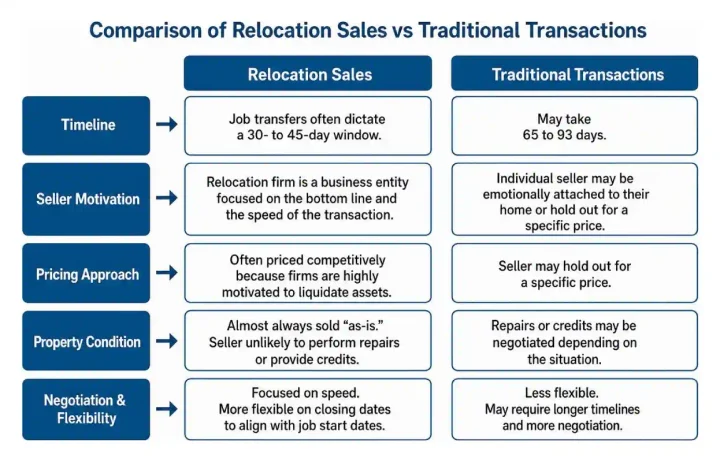
While a traditional real estate transaction might take 65 to 93 days, job transfers often dictate a 30- to 45-day window. This “timeline gap” is the primary source of stress for relocating families. Successfully navigating this requires a shift from standard market expectations to a strategy focused on speed and high-impact visibility.
Preparing the Property for a Rapid Market Listing
When time is of the essence, you cannot afford to waste weeks on major renovations. Instead, focus on the “quick-win” repairs that offer the highest return on investment. For example, upgrading a garage door can yield an average return of nearly 94%, significantly boosting curb appeal with minimal effort.
Decluttering is equally critical. We recommend the “three-pile” method: keep, donate/discard, and store. By removing personal items, family photos, and bold decor, you create a neutral canvas that allows potential buyers to envision themselves in the space. Professional staging, even if limited to the main living areas, can make a massive difference in the speed of an offer.
Remote Selling Strategies and Bridging Financial Gaps
If you have already relocated, you may find yourself managing the sale from thousands of miles away. Modern technology has made this entirely feasible through digital signatures and virtual walkthroughs. You do not need to be physically present to oversee the process.
For those worried about the financial strain of purchasing a new home before the old one sells, there are several “buy-before-you-sell” models. These programs allow you to unlock your current home’s equity to fund your new down payment. If you prefer to avoid traditional brokerage models, you might explore commission-free as-is property sales to bypass the lengthy listing process and move directly to a closing date that aligns with your start date.
Buying a Relocation Property: Risks, Benefits, and Due Diligence
Purchasing a home from a relocation firm can be a strategic advantage for the right buyer. Because these properties are often owned by corporations that are highly motivated to liquidate assets, they can be priced competitively.
Navigating Buyer Due Diligence in Property Sales and Relocation
Relocation properties are almost always sold “as-is.” This means the company is unlikely to perform repairs or provide extensive credits for minor cosmetic issues. As a buyer, your due diligence is your most important tool. You must hire a qualified, independent home inspector to verify the property’s condition. While the corporate seller may be exempt from certain disclosure requirements that individual homeowners must provide, a thorough inspection will reveal any structural concerns that could affect your investment.
Comparing Relocation Purchases to Traditional Real Estate Transactions
The primary difference lies in the motivation. A traditional seller may be emotionally attached to their home or hold out for a specific price. A relocation firm is a business entity; they are focused on the bottom line and the speed of the transaction.
Coordinating Moving Logistics and Cross-Country Transitions
The final piece of the puzzle is the physical move. Coordinating the sale of your home with the arrival of your moving truck requires a synchronized timeline.
Seamless Relocation Planning and Execution
Managing a cross-country move is a complex task. Beyond just packing boxes, you need to ensure that your belongings are handled by professionals who understand the specific needs of long-distance transit. For high-value items or a stress-free transition, we suggest utilizing premium residential moving services. These experts can handle the logistics of packing, loading, and unpacking, allowing you to focus your energy on settling into your new community rather than managing the mechanics of a moving van.
Frequently Asked Questions About Relocation Real Estate
What is the difference between a BVO and a GPO in relocation programs?
A Buyer Value Option (BVO) relies on the market to set the price, with the RMC stepping in to purchase the home at the offer price you secure. A Guaranteed Purchase Offer (GPO) provides a floor price based on appraisals, guaranteeing you a sale even if the market fails to produce an offer within a specific timeframe.
Can buyers negotiate repairs on properties sold by relocation firms?
Generally, no. Because these firms are acting on behalf of a corporation, they typically utilize “as-is” addendums. While you can negotiate price or closing cost credits based on significant inspection findings, do not expect the seller to fix a leaky faucet or replace a carpet.
How can relocating homeowners avoid carrying two mortgages simultaneously?
The most effective strategies include using bridge loans, equity advance programs, or choosing a “buy-before-you-sell” financing model. Additionally, working with a real estate team that specializes in rapid, remote-capable sales can help you list and close on your home before your new job even begins.
Conclusion
Relocating for a career opportunity is a significant life event that demands strategic planning. By understanding the nuances of how relocation companies operate, preparing your home for a rapid market entry, and utilizing the right financial tools, you can transform a potentially stressful move into a seamless transition. The goal is to align your home sale with your professional timeline, ensuring that you arrive at your new destination ready to succeed, not bogged down by the logistics of your previous residence. With the right team and a proactive approach, you can navigate the complexities of property sales and relocation with ease.