
How to Choose the Right Storage Unit Size
Choosing the right storage unit size begins by matching your items to the actual floor space. A 5′ x 5′ unit and a 10′ x 10′ unit may sound close if you are thinking in “small” and “medium,” but the second gives you four times the floor area.
Most mistakes happen because people estimate by room count alone. That misses bulky items, ceiling height, aisle space, and whether boxes are stackable. A better approach is to measure your largest items, count boxes, and decide whether you need walk-in access during storage.
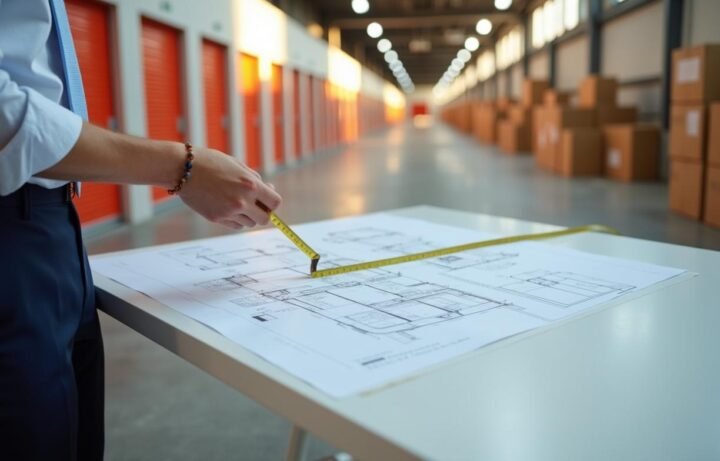
Start With What Storage Unit Sizes Actually Mean
Storage units are usually listed by floor dimensions, such as 5′ x 10′ or 10′ x 20′. Most standard units are about 8 feet tall, though some facilities offer 10-foot ceilings or taller warehouse-style units. That vertical space matters if you can safely stack boxes or stand mattresses upright.
A 10′ x 10′ unit has 100 square feet of floor space and, at an 8-foot ceiling, about 800 cubic feet of volume. But usable space is lower because furniture has odd shapes, boxes need stable stacking, and you may need a center aisle. The Self Storage Association reports that the United States has more than 50,000 self-storage facilities, so size labels are common, but unit shapes and door openings still differ by site.
Door size is easy to overlook. A typical roll-up storage door may be around 8 feet wide on larger units, while smaller units may have swing doors closer to 3 feet wide. If you are storing a sectional sofa, king mattress, refrigerator, or commercial shelving, ask for the door width before reserving.
Common Unit Sizes and What They Usually Hold
The easiest way to compare units is by both square footage and a realistic use case. A tightly packed unit can hold more, but only if you do not need to retrieve items often.
| Unit size | Square feet | Typical fit | Best for |
|---|---|---|---|
| 5′ x 5′ | 25 | Closet contents, 8–12 small boxes, seasonal items | Dorm overflow or sports gear |
| 5′ x 10′ | 50 | Studio items, twin bed, dresser, 20–30 boxes | Small apartment storage |
| 10′ x 10′ | 100 | One-bedroom apartment, appliances, sofa, 40–60 boxes | Moving between leases |
| 10′ x 15′ | 150 | Two-bedroom apartment, dining set, large appliances | Family downsizing |
| 10′ x 20′ | 200 | Three-bedroom home or standard vehicle | Whole-home move or car storage |
| 10′ x 30′ | 300 | Four-bedroom home, business inventory, equipment | Large relocation or contractor storage |
A 5′ x 5′ unit is about the size of a small walk-in closet. It can handle boxed holiday decorations, luggage, golf clubs, tools, or a compact bookcase. It will not comfortably hold a queen mattress flat, since a queen mattress is 60″ x 80″.
A 5′ x 10′ unit is often compared to a large walk-in closet. It can fit a queen mattress set if stored on its side, a small dresser, boxes, and a few chairs. It becomes cramped quickly if you add a couch over 7 feet long.
A 10′ x 10′ unit is one of the most commonly rented sizes because it fits many one-bedroom moves. If you are storing a couch, mattress, table, chairs, TV stand, and boxed kitchenware, this size usually gives enough room without forcing unsafe stacks.
A 10′ x 20′ unit is close to a standard one-car garage. The U.S. Department of Energy notes that many single-car garages are commonly designed around 12′ x 20′ or larger, so a 10′ x 20′ unit is useful for household goods but tighter for maneuvering a vehicle.
Measure the Items That Decide the Unit
Large items set the minimum size. Small boxes can fill gaps, but a mattress, sofa, dining table, desk, or refrigerator cannot shrink. Measure length, width, and height for anything over 4 feet long.
Furniture and Mattresses
A king mattress is 76″ x 80″, while a California king is 72″ x 84″. A queen is 60″ x 80″, and a full mattress is 54″ x 75″. These dimensions are standardized by the International Sleep Products Association and major bedding manufacturers, so they are reliable planning numbers.
Mattresses should usually be stored upright only for short periods, such as a few weeks during a move. For several months, flat storage is better because long vertical pressure can distort foam or springs. If flat storage is not possible, choose a unit tall enough to stand the mattress without bending it and place it against a clean wall.
Sofas vary more. A typical three-seat sofa is 72 to 96 inches long. Sectionals can exceed 10 feet in one direction, and many have pieces that do not stack well. Remove legs if possible, and measure the longest piece after disassembly.
Appliances and Odd-Shaped Items
A standard refrigerator is often 30 to 36 inches wide and 65 to 70 inches tall. Leave refrigerator doors slightly open in storage to prevent trapped moisture. The U.S. Environmental Protection Agency warns that moisture supports mold growth when humidity stays high, especially above 60% relative humidity.
Washers and dryers are usually about 27 inches wide each. Front-load washers should be drained before storage because leftover water in hoses and seals can cause odor. If you are storing appliances through winter in an unheated unit, drain hoses carefully before freezing temperatures arrive.
Bicycles, patio furniture, lawn equipment, and baby gear take more room than boxes because they do not stack cleanly. A push mower can use as much floor area as six medium boxes. Gas-powered equipment should be stored with fuel drained or stabilized according to the manufacturer’s manual.
Choose Based on Your Situation, Not Just Your Home Size
Room count is useful, but it should not be the only factor. Two one-bedroom apartments can require different units if one has flat-pack furniture and the other has a king bed, sectional sofa, and outdoor equipment.
| Situation | Better choice | Why it fits |
|---|---|---|
| Storing dorm items for summer | 5′ x 5′ | Usually enough for bedding, mini fridge, boxes, and small furniture |
| Studio apartment with no large sofa | 5′ x 10′ | Handles mattress, dresser, boxes, and compact furniture |
| One-bedroom move with couch and appliances | 10′ x 10′ | Gives room for bulky furniture and stacked boxes |
| Two-bedroom apartment with dining set | 10′ x 15′ | Adds space for table, chairs, and extra mattresses |
| Three-bedroom home during a move | 10′ x 20′ | Similar footprint to a small garage |
| Business inventory with access needed weekly | Size up one category | Aisles reduce usable floor area by 15–25% |
If you need regular access, choose a unit larger than your packed volume suggests. A 24-inch aisle is enough for walking, but 30 to 36 inches is better if you will carry bins or remove furniture. That aisle can consume 20 square feet in a 10′ x 10′ unit.
If you are storing for less than 30 days and will unload everything at once, a tighter fit is acceptable. Movers often pack trucks with little walking space because the load is temporary. A storage unit used for six months should be easier to enter, inspect, and ventilate.
If you have many fragile items, size up. Artwork, mirrors, lamps, electronics, and antiques should not sit under heavy boxes. The Smithsonian Institution’s Museum Conservation Institute recommends stable, moderate environments for sensitive materials, and avoiding physical stress is part of proper object care.
If you are storing business inventory, do not calculate by square footage alone. Count cartons by pallet or shelf. A standard GMA pallet is 48″ x 40″, and it uses about 13.3 square feet before aisle space. Four pallets can technically fit in a 10′ x 10′ unit, but access will be poor without stacking or shelving.
Use a Simple Packing Calculation Before You Reserve
Start with box count. A standard medium moving box is often about 18″ x 18″ x 16″, or roughly 3 cubic feet. Thirty medium boxes equal about 90 cubic feet before gaps, fragile spacing, or aisle space.
Next, add your bulky pieces. A queen mattress stored upright uses only about 7 square feet of floor area, but a sofa may use 15 to 25 square feet depending on length and depth. A dining table may use less space if the legs come off; if not, it can block stackable floor area.
A Fast Sizing Formula
Estimate cubic feet, then compare it with the unit’s volume. Multiply unit length by width by height. A 5′ x 10′ x 8′ unit equals 400 cubic feet, while a 10′ x 10′ x 8′ unit equals 800 cubic feet.
Use only 65–75% of the theoretical volume if you have mixed furniture and boxes. That means a 10′ x 10′ unit may provide about 520 to 600 usable cubic feet in normal household storage. If nearly everything is uniform boxes, usable volume can be higher.
For a one-bedroom apartment, 40 medium boxes take about 120 cubic feet. Add a queen bed, sofa, dresser, TV stand, small table, chairs, and kitchen items, and a 10′ x 10′ unit becomes more realistic than a 5′ x 10′. The smaller unit may fit only if furniture is minimal and well disassembled.
Plan the Loading Order
Put items you will need first near the door. That includes tools, seasonal clothing, business files, or children’s gear. Load rarely used items, bed frames, and sealed long-term boxes toward the back.
Keep heavy boxes low and stack lighter boxes above them. Use shelves if you need access to small inventory or documents. Cardboard loses strength when humidity rises, so plastic bins are better for long storage or damp climates.
Leave air gaps around walls if storing wood furniture, leather, photos, or fabric. A 1- to 2-inch gap improves airflow and reduces the chance that condensation transfers from the wall to your items. Avoid pressing upholstered furniture directly against concrete.
When Climate Control Changes the Size Decision
Climate-controlled units usually maintain temperatures within a managed range, often around 55°F to 85°F, depending on the facility. They are not the same as museum storage, but they reduce extreme heat, cold, and humidity swings.
Climate control matters for wood furniture, musical instruments, electronics, vinyl records, photographs, leather, mattresses, and documents. The National Archives recommends cool, dry, stable conditions for paper records, with relative humidity generally controlled to reduce mold and deterioration risks.
If you choose climate control, you may need to size differently because many climate-controlled units are inside buildings. Hallways, elevators, and interior door widths can restrict large furniture. Ask whether carts are available and whether elevator doors can handle items over 80 inches long.
For hot or humid regions, climate control can also reduce packing bulk. You may not need as many protective coverings, moisture absorbers, or sealed plastic totes for sensitive belongings. Still, never wrap wood or leather tightly in plastic for long periods, because trapped moisture can stain surfaces.
Do Not Forget Access, Insurance, and Facility Rules
Size is not only about what fits inside the room. It is also about how you unload. A drive-up 10′ x 15′ unit may be easier to use than an interior 10′ x 20′ unit if you have heavy furniture and no freight elevator.
Ask about vehicle access before move-in day. A 26-foot moving truck needs more turning room than a pickup, and some older facilities have narrow lanes. If the facility has gates, confirm access hours; many sites offer extended gate access from early morning to late evening, but not true 24-hour access.
Insurance may affect how you pack the unit. Many storage leases require proof of stored-property coverage, either through your homeowners or renters policy or through a facility plan. Before buying coverage, check whether your policy limits off-premises personal property to 10% of your normal personal property coverage.
Facility rules can also change what size works. Most facilities prohibit food, hazardous materials, live plants, tires beyond a small limit, and flammable liquids. If you planned to store garage contents, remove paint, propane tanks, pesticides, gasoline, and cleaning chemicals before estimating the final load.
Quick Checks Before You Commit
Visit the unit if possible before signing. Stand inside and picture your largest item crossing the doorway. A unit that looks big online can feel different when the door opening is narrow or the ceiling has beams.
Mark out the unit footprint at home with painter’s tape. A 10′ x 10′ square in a garage or driveway gives a better sense of packing density than a photo. Place your largest items in the outline first, then add box stacks.
Reserve the smaller unit only when your measurements prove it works. Move up when you need aisle access, have many fragile items, or are storing longer than three months. A slightly larger unit is often easier to manage than repacking everything on move-in day.