Standby Generator Sizing Guide for Small Homes
A small home does not need the same generator as a large house with two HVAC systems, an electric range, and a pool pump. The right size depends on starting watts, running watts, fuel type, transfer equipment, and which loads you truly need during an outage.
This standby generator sizing guide focuses on small homes, typically under 1,500 square feet, with one heating or cooling system and standard appliances. The goal is to avoid buying a generator that trips under load, but also avoid oversizing equipment that burns more fuel than needed.
Start with the loads you actually need
A standby generator should be sized from the circuits it will power, not from square footage alone. A 1,000-square-foot all-electric cottage may need more generator capacity than a 1,400-square-foot gas-heated home.
Start with essentials: refrigerator, freezer, furnace blower, well pump, sump pump, internet equipment, lighting, garage door opener, and a few receptacles. If your home uses central air, electric water heating, or an electric range, those loads change the calculation quickly.
The National Electrical Code, published as NFPA 70 by the National Fire Protection Association, requires generator installations to follow transfer equipment and wiring rules that prevent backfeeding utility lines. That matters because a standby unit must connect through an approved transfer switch, not a dryer outlet or improvised cord.
For many small homes, a practical essential-loads generator lands between 7 kW and 14 kW. A whole-home setup for a small house often falls between 14 kW and 22 kW, especially when central air or electric heat enters the plan.
Running watts and starting watts are different
Running watts are the steady watts an appliance uses after it is operating. Starting watts are the short surge needed by motors and compressors during startup, often lasting less than three seconds.
A refrigerator may run at 200 to 800 watts, but need 1,200 to 2,200 watts at startup. A 1/2-horsepower sump pump may run near 1,000 watts, yet surge to 2,000 watts or more when the motor starts.
Central air creates the biggest sizing challenge in many small homes. A 2-ton air conditioner may need around 2,000 to 3,500 running watts, but its locked-rotor startup demand can be several times higher without a soft-start kit.
The U.S. Energy Information Administration notes that space cooling is a major driver of residential electricity use, especially in warmer regions. If you live in a hot climate and need air conditioning during outages, the generator must handle compressor startup without dropping voltage too far.
Estimate the right generator size
List every circuit you want powered, then write the running watts and highest starting watts for each motor load. Appliance nameplates, owner’s manuals, and HVAC data plates provide better numbers than generic charts.
Add all running watts for loads that may operate at the same time. Then add the largest single starting-watt surge on top, since most motors do not start at the exact same instant.
For example, a small gas-heated home might have a 700-watt refrigerator, 600-watt furnace blower, 1,000-watt sump pump, 800 watts of lights and outlets, 300 watts of internet gear, and a 1,200-watt microwave. That is 4,600 running watts before startup allowance.
If the sump pump needs a 2,000-watt startup surge, the estimate becomes about 5,600 watts. Adding a 20% margin puts the target near 6,700 watts, so an 8 kW standby generator would make sense.
Choose essential-loads or whole-home coverage
This is the decision that shapes the installation. Essential-loads systems use a smaller generator and a transfer switch panel with selected circuits. Whole-home systems use a larger generator and often pair with load management modules.
| Situation | Better fit | Typical generator size |
|---|---|---|
| Gas furnace, city water, no central air needed | Essential loads | 7 kW to 10 kW |
| Gas furnace, sump pump, well pump, refrigerator, freezer | Essential loads with careful pump sizing | 10 kW to 14 kW |
| Small home with 2-ton central air | Managed whole-home or large essential-loads setup | 14 kW to 18 kW |
| Electric water heater and electric range included | Whole-home with load management | 18 kW to 22 kW |
| Electric heat strips or multiple large resistance loads | Usually not practical without shedding loads | 22 kW or larger |
When essential-loads sizing fits
Essential-loads sizing works well when the home has natural gas or propane heat, a modest number of motor loads, and no need to run an electric oven or clothes dryer. It also fits homeowners who can avoid using multiple high-draw devices at once.
A 10 kW standby unit can often support a refrigerator, freezer, furnace blower, sump pump, lights, electronics, and a microwave in a small home. If a well pump and sump pump may start close together, a 12 kW or 14 kW unit gives more headroom.
This option usually needs a smaller transfer switch, fewer load controls, and less fuel capacity. Installed prices for essential-load standby systems commonly run from $5,000 to $9,000, depending on electrical work, gas piping, permits, and pad placement.
When whole-home sizing fits
Whole-home sizing fits when you want normal operation during a long outage. It also fits homes where medical devices, remote work, basement flood risk, or extreme temperatures make selective power too limiting.
A 16 kW to 22 kW standby generator can often support a small home if large loads are managed. Load management temporarily locks out appliances such as electric water heaters, ranges, or air conditioners when generator demand gets too high.
The Electrical Generating Systems Association recommends professional load analysis because motor-starting requirements and voltage dip limits affect real-world performance. A generator that looks large enough on running watts may still struggle when an air conditioner starts.
Account for fuel type, altitude, and location
Natural gas standby generators are convenient because they connect to the utility supply. Propane works well where gas service is unavailable, but tank size affects runtime during multi-day outages.
A small standby generator can use roughly 1 to 3 gallons of propane per hour, depending on load and model. A 250-gallon propane tank holds about 200 usable gallons because tanks are normally filled to 80% capacity.
Altitude and temperature can reduce output. Many engine-driven generators lose about 3% power for every 1,000 feet above sea level, though the exact derating comes from the manufacturer’s specifications.
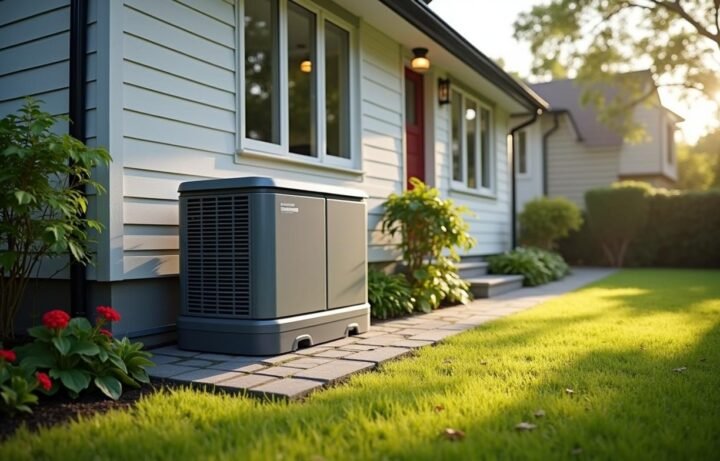
Placement rules also matter. Manufacturers commonly require at least 18 inches from the house wall, 5 feet from operable windows or doors, and 3 feet of clearance on service sides, but local codes and listing instructions control the final location.
Avoid the common sizing mistakes
Do not size a generator from the main breaker alone. A 200-amp service does not mean the home needs a 48 kW generator, because residential panels rarely carry full rated load continuously.
Do not ignore electric resistance loads. Electric heat strips, tank water heaters, baseboard heaters, clothes dryers, and ranges can each draw 4,000 to 12,000 watts, which can overwhelm a small standby unit quickly.
Do not forget maintenance power losses. A generator that runs near maximum output for hours has less room for motor starts, dirty air filters, fuel-pressure drops, or hot-weather derating.
Before ordering equipment, ask the installer for a written load calculation, the selected transfer switch type, the fuel-pressure requirement, and the proposed load-shedding sequence. The calculation should identify running watts, starting loads, and any appliances excluded from generator power.