Driveway Sealing Before Cold Weather Damage Sets In
Cold weather turns small pavement flaws into larger repairs because water gets into pores and cracks, then expands as it freezes. The Federal Highway Administration explains that freeze-thaw damage accelerates when pavement has open cracks, trapped moisture, and repeated temperature swings around 32°F.
Late summer and early fall are the practical window for driveway sealing because asphalt needs warmth, dry weather, and curing time. Waiting until the first hard freeze often means the surface will stay damp, shaded, or too cold for sealer to bond correctly.
Why cold weather is hard on asphalt
Asphalt is flexible, but it is not waterproof. Sunlight oxidizes the binder, tires wear away fines, and rain carries grit into small openings. Once the surface turns gray instead of black, the asphalt binder has usually lost some of its oil-rich flexibility.
The Asphalt Institute notes that asphalt pavement performance depends heavily on drainage, with its engineers calling adequate drainage the most important element in long-term pavement performance. When water reaches the base layer, repeated traffic can pump fine material out from under the driveway. That often shows up as alligator cracking, low spots, or edges that crumble under vehicle weight.
Freeze-thaw cycles cause the most visible damage when daytime temperatures rise above freezing and nighttime temperatures fall below it. One cold week may not ruin a driveway. Twenty or thirty freeze-thaw cycles during a winter can widen hairline cracks into gaps over 1/4 inch.
The damage starts before snow arrives
The most important deadline is not the first snowfall. It is the first stretch of nights below 50°F, because many asphalt sealers need that minimum temperature during application and early curing.
Acrylic and coal-tar alternatives vary by product, but many consumer and contractor-grade asphalt emulsion sealers require pavement and air temperatures of at least 50°F for 24 hours. If the driveway stays shaded by trees or a north-facing garage, the surface may remain colder than the forecast air temperature for several hours after sunrise.
When to seal before temperatures drop
Plan the work when the pavement temperature stays between 50°F and 90°F. The best working range is usually 60°F to 80°F, because the sealer spreads evenly and does not flash-dry before it bonds.
You also need a dry forecast. Most asphalt emulsion sealers need at least 24 hours without rain, and some need 48 hours before heavy traffic. Morning dew matters, too. If the driveway is wet at 8 a.m., sealing at 9 a.m. can trap moisture below the coating.
For many northern states, the practical cutoff falls between mid-September and mid-October. In milder regions, sealing may remain possible into November. NOAA climate normals can help you compare your local average first freeze date against the cure time printed on the sealer label.
Use surface conditions, not just the calendar
A driveway does not need sealing every year. Many residential asphalt driveways benefit from sealing every two to four years, depending on sun exposure, drainage, traffic weight, and previous coating thickness.
Seal too often and the surface can build up a slick, layered coating that scuffs under tires. Wait too long and oxidation lets water penetrate deeper than a maintenance coat can reach. A driveway that looks light gray, sheds sand, or absorbs water quickly is a stronger candidate than one that still looks uniformly black.
Repair cracks before sealing
Sealer is a surface coating, not a structural repair. It can reduce water entry through tiny pores, but it cannot bridge moving cracks or rebuild a softened base.
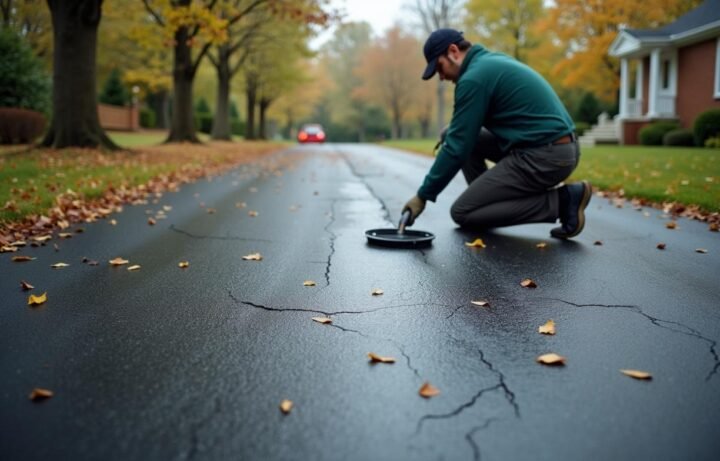
Cracks wider than 1/8 inch should usually be cleaned and filled before sealing. Cracks wider than 1/2 inch may need backer rod or a patching compound, because liquid crack filler can sink too deeply and fail at the surface. Remove grass, dirt, and loose aggregate with a screwdriver, wire brush, blower, or pressure washer before filling.
Potholes need patching before any coating goes down. A cold patch should be compacted in 1- to 2-inch lifts, not dumped in one deep hole. The U.S. Army Corps of Engineers pavement maintenance guidance emphasizes that patch performance depends on removing loose material and compacting the repair into a firm, confined area.
Crack filler timing matters
Most crack fillers need several hours to skin over before sealer touches them. Some rubberized fillers need 24 hours, especially in cool weather or shaded areas.
If a filled crack remains tacky, sealer can smear it across the driveway. That leaves shiny streaks and weak spots. Read the product label for cure time, then add extra time when temperatures sit near the minimum application limit.
Which option fits your driveway?
The right approach depends on pavement age, crack width, drainage, and how soon cold weather arrives. A five-year-old driveway with light fading needs different care than a twenty-year-old driveway with base movement.
| Situation | Best option | Conditions that make it fit |
|---|---|---|
| Surface is gray, but cracks are under 1/8 inch | Clean and seal | Pavement is firm, water drains away, and temperatures stay above 50°F for 24 hours |
| Several cracks measure 1/8 to 1/2 inch | Fill cracks, then seal | Cracks are stable, edges are not sinking, and there is time for filler to cure |
| Potholes or alligator cracking appear | Patch or evaluate base first | Damage covers more than a few square feet, or the surface flexes under tires |
| Sealer was applied last year and still looks black | Wait | Water beads on the surface, and no open cracks have formed |
| First freeze is less than 48 hours away | Delay coating | Crack filling may still help if the product allows cool-weather use |
A homeowner-grade sealer project often runs about $40 to $120 in materials for a typical two-car driveway, depending on driveway size and crack repair needs. Hiring a contractor makes more sense when the driveway is large, badly oxidized, or needs machine cleaning before coating.
Choose sealer type by exposure
Asphalt emulsion sealers are common for residential use because they have lower odor and easier cleanup than older coal-tar products. Some municipalities restrict coal-tar sealers because they contain high levels of polycyclic aromatic hydrocarbons, which the U.S. Geological Survey has linked to urban runoff contamination.
Acrylic sealers can handle UV exposure well, but they cost more and may not be necessary for a shaded driveway with moderate traffic. Sand-filled commercial mixes improve traction and wear resistance, especially where tires turn sharply near a garage apron.
Choose timing by risk
If you have four dry days and daytime highs near 65°F, sealing after crack repair is usually reasonable. Should highs sit near 52°F and nights drop into the low 40s, focus on crack filling and drainage instead.
If water runs from a downspout across the driveway, fix that before coating. Extend the downspout at least 5 feet away from the pavement edge, or route water to a proper drain. A sealed surface still fails quickly when water enters from the side or sits along a low edge.
Prep steps that make the coating last
Start by cleaning the driveway thoroughly. Sweep loose grit, remove leaves from edges, and scrub oil spots with a degreaser made for asphalt. Oil prevents adhesion, and a dark stain larger than a dinner plate often needs repeated cleaning.
Pressure washing can help, but the driveway must dry completely afterward. In fall weather, that may take 24 to 48 hours. Pay attention to cracks, low spots, and the shaded strip along the garage door, since those areas dry last.
Apply thin coats instead of one heavy coat. Many manufacturers specify two thin coats, with the second coat applied perpendicular to the first after the first has dried. A heavy coat can skin over on top while staying soft below, which leads to tracking and tire marks.
Use a squeegee or brush near edges, then work in manageable sections of about 4 by 4 feet. Keep traffic off the driveway for the full cure period listed on the pail. Foot traffic may be allowed sooner, but parked tires create more pressure and heat than shoes.
Mistakes that invite winter damage
Do not seal over damp pavement. Moisture under sealer can create milky patches, weak bonding, and early peeling after the first freeze.
Do not ignore edge cracks. Driveway edges lack the same support as the center lane, especially where soil has washed away. Add compacted soil or gravel along unsupported edges so tires do not break the asphalt shoulder.
Do not seal brand-new asphalt too soon. Many installers recommend waiting at least 90 days before sealing new asphalt, and longer if the surface still feels soft in hot weather. Fresh asphalt needs time for light oils to evaporate before a coating locks the surface.
Do not treat sealer as a fix for drainage or base failure. If a section sinks more than 1/2 inch, holds water for longer than 24 hours, or shows interconnected alligator cracks, a surface coat will hide symptoms without stopping winter movement.