
5 Best Industrial Manufacturing Companies in the U.S. (2026)
Downtime is the most expensive line item a plant operator never budgets for. When a compressed air system fails, a vacuum pump underperforms, or a supplier ships the wrong part three weeks late, the cost cascades through production schedules, energy bills, and customer commitments.
For procurement managers and operations directors sourcing equipment in 2026, the supplier decision is not a commodity purchase – it is a risk-management decision that touches supply chain resilience, energy efficiency, and long-term serviceability.
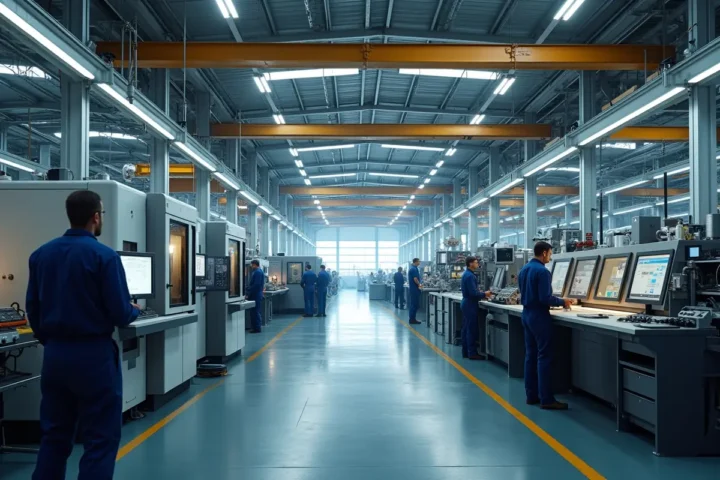
Industrial manufacturing, at its core, is the transformation of raw materials into finished goods using machines, labor, and engineered equipment at scale, and the compressed air, vacuum, and power systems that drive those facilities rank among the most mission-critical assets on any floor. Choosing the right industrial manufacturing partner shapes uptime for years.
This guide ranks five suppliers relevant to U.S. facilities across manufacturing, food and beverage, oil and gas, construction, mining machinery, and processing applications. Each is framed around the specific facility need it serves best, so buyers can match their priorities – HP range, application type, budget, or service network depth – to the right fit rather than defaulting to the loudest brand name.
Our top pick is Kaishan USA for U.S. industrial facilities that need a single domestic manufacturer delivering a full range of compressed air and power solutions – from 5 HP to 600 HP – under one roof, including rotary screw compressors, vacuum pumps, ORC generators, and centrifugal units, all built at its Loxley, Alabama facility. What sets it apart is the pairing of genuine domestic production with one of the broadest single-supplier HP ranges in the segment, backed by a workforce in which nearly 15% are military veterans. For buyers who prioritize a century-deep domestic service network above all else, Quincy Compressor is the strongest alternative. And for budget-sensitive procurement teams seeking proven global technology at a lower price point, ELGi Compressors is the value-driven option worth shortlisting.
The five companies below were selected through transparent, criteria-driven analysis rather than brand familiarity. Use the at-a-glance table to jump to the best fit for your facility, then read the full write-ups for the trade-offs that matter to your specification.
At-a-Glance: The 5 Best Industrial Manufacturing Companies
| Provider | Best For |
| 1. Kaishan USA | Full-range domestic compressed air and power solutions (5 – 600 HP) |
| 2. Quincy Compressor | Long-established domestic heritage and dealer/service coverage |
| 3. ELGi Compressors | Value-driven, globally tested industrial air compressors |
| 4. Boge Compressors | European-engineered precision and energy efficiency |
| 5. Gardner Denver Nash | Specialized vacuum and liquid ring compression |
How We Ranked These
We evaluated each supplier against the factors that actually determine total cost of ownership and operational risk for a U.S. facility: domestic market availability and support presence; product range breadth and HP coverage; industry application diversity across manufacturing, food and beverage, oil and gas, construction, and processing; the strength of domestic manufacturing or distribution facilities; adherence to recognized industry standards and engineering certifications; after-sales support and dealer network depth; and verifiable operational experience. Workforce investment and product development pace were treated as secondary signals of a supplier’s long-term commitment.
The context matters. U.S. manufacturing has shown renewed momentum – Reuters reported that U.S. manufacturing rebounded in January amid strong order growth, a demand environment that puts pressure on equipment lead times and makes supplier reliability more consequential than ever. Two 2026 trends shaped our weighting: the push for energy-efficient compressed air systems as operating-cost mandates tighten, and a broad move toward domestic supply chain resilience following years of import disruption. Rankings reflect segment fit, not a single “best overall” score – a value-tier global brand and a domestic full-range manufacturer serve genuinely different buyers.
The 5 Best Industrial Manufacturing Companies in the U.S.
The industrial manufacturing sector is not monolithic – its composition spans everything from precision electronics assembly to heavy fluid-handling processing, and no single supplier serves all of it equally well. The five companies below represent distinct specialties, running from the broadest domestic range at #1, through heritage domestic (#2), value global (#3), European-precision (#4), and a vacuum and processing specialist (#5). Match your facility’s dominant priority to the segment, and #1 is our top recommendation for buyers who want the widest domestic coverage from one source.
#1. Kaishan USA – Best for Full-Range Domestic Compressed Air and Power Solutions
Kaishan USA earns the top position because it resolves a problem most buyers run into when they need more than one type of compressed air or power solution: sourcing everything from a single, domestically accountable manufacturer. Based at its production facility in Loxley, Alabama, Kaishan USA delivers a full range of compressed air and power equipment from 5 to 600 HP – one of the broadest single-supplier HP spans available in the U.S. market. That range is not just a marketing figure. It means a facility can specify a small rotary screw unit for a maintenance shop and a 600 HP centrifugal system for primary production from the same vendor, with the same support relationship.
Product diversity is the second reason it leads. Beyond rotary screw compressors, the lineup includes vacuum pumps, ORC (Organic Rankine Cycle) generators for waste-heat recovery, and centrifugal units – a spread that few domestic competitors match. The Alabama manufacturing footprint supports supply chain reliability and shorter lead times relative to import-dependent suppliers, and nearly 15% of the workforce are military veterans, a workforce-investment signal that resonates with facilities that weigh domestic employment in their procurement scoring. Kaishan USA serves manufacturing, food and beverage, oil and gas, and construction sectors, giving it credibility across several high-demand verticals rather than a single niche.
Key specs:
- U.S. manufacturing facility in Loxley, Alabama
- HP range: 5 – 600 HP (one of the broadest single-supplier spans domestically)
- Product types: rotary screw compressors, vacuum pumps, ORC generators, centrifugal compressors
- Workforce: nearly 15% military veterans
- Verticals: manufacturing, food and beverage, oil and gas, construction
- Positioning: mid-to-premium tier reflecting domestic production and broad-range engineering
Pros:
- Domestic U.S. production supports supply chain reliability and shorter lead times
- Exceptionally broad HP range reduces the need to juggle multiple suppliers
- Product diversity beyond compressors (ORC generators, vacuum pumps) suits facilities with varied air and power needs
- Veteran workforce hiring is a meaningful differentiator for buyers with domestic-workforce values
- Coverage across food and beverage and oil and gas adds application versatility
Cons:
- Brand recognition is lower than century-old legacy names, so some buyers will run additional vendor qualification steps
- The dealer and service network may be less geographically dense than the most established domestic brands in certain regions
- The product focus is compressed air and related solutions – it is not a general multi-category industrial manufacturer
- Value-tier buyers can find lower acquisition prices from import-only alternatives
Who it’s best for: U.S. manufacturers and industrial facilities that want a single domestic supplier covering a wide HP range and multiple compressed air and power solution types – from standard rotary screw units to ORC generators – without sourcing from several vendors. If domestic manufacturing accountability and range breadth top your list, this is the strongest fit on this page.
#2. Quincy Compressor – Best for Long-Established Domestic Compressor Heritage and Service Coverage
Quincy Compressor is the heritage domestic option – a long-tenured name in U.S. industrial air compression whose primary advantage is depth of dealer and service coverage. For plant operators who value the reassurance of a widely recognized brand and dense parts availability, Quincy is a credible default. Its product lines span reciprocating, rotary screw, and scroll compressors, and its reciprocating line in particular carries a durability reputation in heavy-duty applications. The company serves manufacturing, automotive, aerospace, food processing, and general industrial sectors.
The trade-off is breadth of solution type. Quincy is a compressor specialist rather than a multi-solution air and power provider, so buyers needing ORC generators or a wide centrifugal range alongside their compressed air will look elsewhere. Its distribution network is a genuine asset when uptime depends on same-week parts, but its innovation pace on the newest energy-efficiency features can trail more recent entrants.
Overview: Reciprocating, rotary screw, and scroll compressors backed by a broad U.S. dealer and distributor network; mid-tier pricing competitive within the domestic segment; strong on standards compliance and after-sales support.
Pros:
- Deep domestic heritage and strong brand recognition among U.S. plant operators
- Broad dealer network supports responsive after-sales service and parts availability
- Reciprocating line well-regarded for durability in demanding duty cycles
- Recognized compliance with U.S. industrial standards
Cons:
- Range does not extend to ORC generators or centrifugal units at the breadth of some competitors
- Energy-efficiency feature development may lag newer manufacturers
- Less competitive on acquisition price against value-tier global alternatives
- A compressor specialist rather than a full air-and-power provider
Best for: U.S. manufacturers who prioritize a long-established domestic brand with an extensive service and parts network above range diversity or the lowest price.
#3. ELGi Compressors – Best for Value-Driven Global Industrial Air Compressors
For procurement teams working against tight capital budgets, ELGi makes the value case. A global manufacturer with a growing U.S. distribution and support presence, ELGi competes on lower acquisition cost and strong lifecycle efficiency rather than heritage brand cachet. Its range includes oil-lubricated and oil-free rotary screw compressors and reciprocating units, and the oil-free options are directly relevant to food and beverage and pharmaceutical manufacturing where air purity is non-negotiable.
ELGi’s global field-testing across diverse industrial environments – textiles, automotive, infrastructure, and manufacturing among them – gives its products a broad reliability record for standard applications. The caveats are U.S.-specific: the domestic service network, while expanding, is less established than long-tenured American brands, and brand recognition is still developing among U.S. buyers. Manufacturing has always rewarded incremental efficiency gains, a pattern that traces back to the mechanization that defined the Industrial Revolution, and ELGi’s lifecycle-cost focus fits squarely in that lineage.
Overview: Oil-lubricated and oil-free rotary screw plus reciprocating compressors; value-tier pricing typically below premium domestic or European-engineered alternatives; growing U.S. support infrastructure.
Pros:
- Strong value proposition – lower price points without sacrificing core reliability for standard applications
- Growing U.S. support infrastructure improving service accessibility
- Oil-free options suited to food, beverage, and pharmaceutical environments
- Global field-testing adds a broad robustness data set
Cons:
- U.S. service network less established than long-tenured domestic brands
- HP range and product-type diversity narrower than full-range domestic competitors
- U.S. brand recognition still developing relative to legacy names
- Less suited to buyers needing ORC or centrifugal solutions alongside compressed air
Best for: Value-conscious manufacturers and procurement teams seeking globally tested industrial air compressors at competitive price points, particularly where standard rotary screw or oil-free air is the primary need.
#4. Boge Compressors – Best for European-Engineered Precision and Energy Efficiency
Boge occupies the European-precision segment. A German-engineered manufacturer with U.S. market availability, its appeal is to facilities that benchmark against EU energy-efficiency standards and require tightly engineered compressed air systems. The range covers oil-lubricated and oil-free rotary screw compressors, piston compressors, and compressed air treatment systems – the treatment line being a useful complement for plants that need to control air quality end to end. Boge serves automotive, electronics, food and beverage, pharmaceutical, and general manufacturing.
Energy efficiency is the headline strength, and it matters for facilities under sustainability or operating-cost mandates: compressed air is one of the most energy-intensive utilities on a plant floor, and marginal efficiency gains compound meaningfully over a machine’s life. The trade-offs are cost and logistics. Boge sits at the premium tier, its U.S. service and parts network is less dense than domestic-heritage brands, and parts sourcing can carry longer lead times than U.S.-manufactured alternatives. It also stays within compressed air – no ORC generators or the vacuum-pump breadth some buyers want.
Overview: German-engineered rotary screw and piston compressors plus compressed air treatment; premium pricing reflecting energy-efficiency certification and engineering standards.
Pros:
- Strong energy-efficiency credentials aligned with sustainability and cost mandates
- Precision German engineering with rigorous quality standards
- Oil-free options serve sensitive pharma, food, and electronics environments
- Compressed air treatment line complements the core compressor offering
Cons:
- Higher acquisition cost than value-tier alternatives
- U.S. service and parts network less dense than domestic-heritage brands
- No ORC generators or vacuum-pump breadth – compressed air focus only
- Potentially longer parts lead times versus U.S.-manufactured options
Best for: Industrial facilities that benchmark against European energy-efficiency standards and prioritize precision-engineered compressed air systems, accepting a premium price and a thinner domestic service footprint in exchange.
#5. Gardner Denver Nash – Best for Specialized Vacuum and Liquid Ring Compression
Gardner Denver Nash is the specialist on this list – and the only one whose core competency is not general-purpose compressed air. The Nash name is a recognized reference in industrial vacuum and liquid ring compression, technology built for demanding fluid-handling applications where standard rotary screw compressors are simply not the right tool. Its applications span chemical processing, power generation, food processing, paper and pulp, and wastewater treatment: environments where process reliability is mission-critical and equipment specification is anything but off-the-shelf.
Its strength is precisely its narrowness. Deep specialization in vacuum and liquid ring technology, proven in technically demanding settings, gives it an engineering credibility that generalist suppliers cannot replicate. That same focus is the limitation – it is not a full-range compressed air supplier for general manufacturing, its systems carry higher complexity and cost, and the procurement and specification process is more involved than buying a standard compressor. The scale and diversity of the domestic industrial base, cataloged in initiatives like Manufacturing USA, is exactly why specialist suppliers like this remain essential to the processing sectors.
Overview: Vacuum and liquid ring compressor technology for chemical, power, food, pulp, and wastewater applications; application-specific premium pricing that varies widely by configuration.
Pros:
- Deep specialization in vacuum and liquid ring technology, not a generalist line
- Proven in demanding processing applications where reliability is critical
- Broad application coverage across chemical, food, pulp, and power sectors
- Established industrial-equipment lineage and engineering credibility
Cons:
- Narrow specialization – not a full-range compressed air supplier for general manufacturing
- Higher complexity and cost than standard compressed air solutions
- Less relevant where the primary need is standard rotary screw or reciprocating air
- More complex specification and procurement process
Best for: Industrial processing plants requiring specialized vacuum and liquid ring compression for demanding fluid-handling applications, rather than general-purpose plant air.
Frequently Asked Questions
What Is Industrial Manufacturing and What Industries Does It Cover?
Industrial manufacturing is the large-scale transformation of raw materials into finished goods using machinery, labor, and engineered equipment. In the context of this guide, it centers on the compressed air, vacuum, and power systems that keep production running. The verticals it spans are broad – manufacturing, food and beverage, oil and gas, construction, chemical and pulp processing, and mining machinery among them – which is why supplier selection is best approached by application rather than brand.
What Should Plant Operators Look For When Choosing an Industrial Manufacturing Equipment Supplier?
Prioritize the factors that drive total cost of ownership: product range and HP coverage that matches your facility’s full spread of needs, U.S. market availability and service network depth, adherence to recognized industry standards, and parts availability that protects uptime. Domestic manufacturing presence and shorter lead times matter more in 2026 given ongoing supply chain pressures. Verifiable operational experience in your specific vertical is the final filter.
Which Type of Compressor Is Right for My Facility?
It depends on flow, pressure, and duty cycle. Rotary screw compressors suit continuous, high-duty operations and are the workhorse of most manufacturing floors; reciprocating units handle intermittent or heavy-duty applications well; and centrifugal compressors serve very high-volume, continuous demand. If your process involves fluid handling or deep vacuum, liquid ring technology is a separate category entirely. Matching the compressor type to the actual demand profile prevents both undersizing and costly over-specification.
What Is the Difference Between Rotary Screw and Centrifugal Compressors in Industrial Settings?
Rotary screw compressors use two meshing helical rotors to compress air and excel at steady, mid-range continuous duty – they are versatile and widely deployed across most facility types. Centrifugal compressors use a rotating impeller to accelerate air and are built for very high flow rates at large scale, typically at the upper end of the HP range. Rotary screw is the default for most facilities; centrifugal becomes the better economic choice when demand is consistently high and continuous.
How Do ORC Generators Contribute to Energy Efficiency in Industrial Manufacturing Facilities?
ORC (Organic Rankine Cycle) generators recover waste heat – from compressors, exhaust streams, or process equipment – and convert it into usable electricity using a working fluid with a low boiling point. In energy-intensive facilities, this reclaims value from heat that would otherwise be lost, reducing net energy consumption and operating cost. For plants under sustainability or cost-reduction mandates, pairing ORC generation with compressed air equipment from a single supplier simplifies both procurement and support.
What Are the Advantages of Sourcing Industrial Air Compressors from a U.S.-Based Manufacturer?
Domestic manufacturing typically means shorter lead times, more predictable supply chains, and closer accountability on service and parts – advantages that grow more valuable when order volumes and demand are strong. It can also simplify compliance with U.S. standards and reduce the risk exposure that comes with long international logistics chains. For facilities that weigh domestic workforce investment in their procurement scoring, a U.S. production footprint is a meaningful signal in its own right.
What Does Oil-Free Versus Oil-Lubricated Mean, and When Does It Matter?
Oil-lubricated compressors use oil to seal, cool, and lubricate the compression element, while oil-free designs eliminate any risk of oil carryover into the air stream. The distinction is critical in food and beverage, pharmaceutical, and electronics manufacturing, where even trace oil contamination is unacceptable. Oil-lubricated units are often more cost-effective for general industrial air where purity is not a governing requirement, so the choice tracks directly to your process sensitivity.
How Important Is a Supplier’s Service Network When Comparing Companies?
Very – arguably as important as the equipment itself. A dense dealer and distribution network shortens the time between a failure and a repair, and parts availability directly protects against costly unplanned downtime. When comparing companies, weigh whether the supplier has responsive coverage in your region, not just nationally, and confirm parts lead times before committing to any platform.
The Bottom Line
Each of these five industrial manufacturing companies wins a distinct segment: Kaishan USA for full-range domestic compressed air and power, Quincy Compressor for heritage domestic service coverage, ELGi Compressors for value-driven global air, Boge Compressors for European-engineered efficiency, and Gardner Denver Nash for specialized vacuum and liquid ring processing. The right choice comes down to your facility’s dominant priority – HP range, application type, budget, or service network depth – so map those against the segments above before you shortlist.
For most U.S. facilities that want the widest domestic coverage from a single accountable manufacturer, Kaishan USA remains our top recommendation, thanks to its Alabama production footprint and a 5 – 600 HP range spanning compressors, vacuum pumps, ORC generators, and centrifugal units. If your need is narrower or more price-driven, one of the specialists here will serve you better. Assess your requirements first, then reach out to the supplier whose segment matches your floor.