High Tech Security with Biometric Gate Access Systems
Frustrating moment when you arrive at your gate, fumbling for a forgotten key or trying to recall a complex code? Traditional access methods, while familiar, often bring inconveniences and security risks. In our modern world, we need solutions that are both highly secure and incredibly convenient.
This is where biometric gate access systems shine. They use your unique biological traits to grant entry, turning your identity into your key. This not only boosts security but also simplifies daily access.
In this extensive guide, we will explore everything you need to know about these advanced security solutions. We’ll cover what a biometric gate access system is, how it works, and the different types of biometric technologies available. We will also look at their many benefits, practical applications, and crucial factors like cost, privacy, and outdoor suitability. By understanding integrated biometric gate access, we aim to empower you with the knowledge to secure your perimeter effectively.
Biometric technology has transitioned from the realm of science fiction into a practical, everyday solution for enhancing security. At its core, a biometric gate access system leverages the unique biological characteristics of individuals to grant or deny entry, transforming how we manage physical security. This section delves into the fundamental concepts, operational mechanisms, and diverse technologies that power these advanced systems.
What is a Biometric Gate Access System?
A biometric gate access system is a sophisticated security solution that identifies and authenticates individuals based on their unique biological traits, such as fingerprints, facial features, or iris patterns, before allowing them access through a gate. Unlike traditional methods like keys, access cards, or PINs, which can be lost, stolen, or shared, biometric systems use an unforgeable credential – the individual’s own identity.
These systems are a critical component of modern access control systems, providing enhanced security automation for various environments, from high-security facilities to residential communities. They are increasingly being adopted in commercial settings to streamline entry and bolster protection.
The Step-by-Step Authentication and Enrollment Process
The operation of a biometric gate access system involves two primary phases: enrollment and authentication.
Enrollment
This initial phase involves capturing a user’s physical characteristics. For example, a biometric reader will scan a fingerprint, face, or iris, converting these unique physical traits into a secure digital template. This template is not a direct image but rather a mathematical hash or algorithm representing the biometric data.
This mathematical representation is then encrypted and stored in a secure database or directly on a user’s credential (like a smart card or mobile device). During enrollment, systems may also capture additional details like user ID and access privileges. For comprehensive support and resources related to managing such systems, many manufacturers offer dedicated Support Portals.
Authentication
When a user attempts to gain access, they present their biometric characteristic to the reader. The system performs a live scan, converts it into a new digital template, and compares it to the stored template. If there’s a match within a predefined tolerance, the system verifies the user’s identity and grants access by sending a signal to unlock the gate.
Modern biometric access control systems can authenticate users in milliseconds, with facial recognition processes taking only a few seconds and fingerprint verification occurring in lightning-fast time. Some advanced systems, like the IrisAccess iA1000, provide authentication speeds of less than 2 seconds for dual iris and face capture.
Fingerprint and Vein Pattern Recognition
Among the various biometric technologies, fingerprint and vein pattern recognition are widely utilized for gate access due to their reliability and user-friendliness.
Fingerprint Recognition
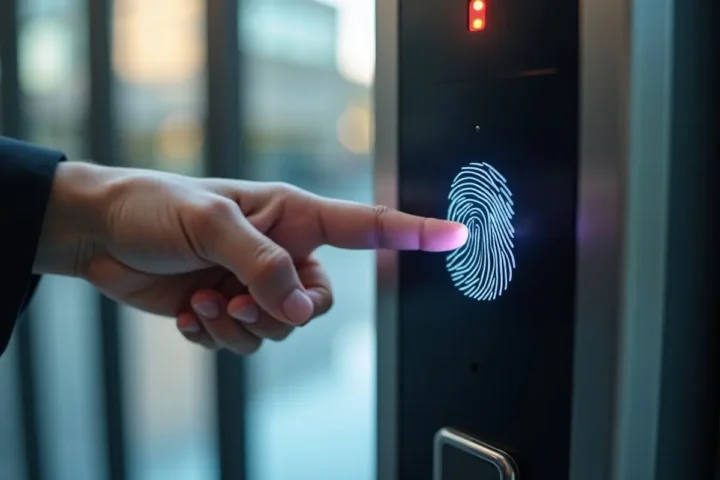
This is arguably the most common and recognizable form of biometric authentication. Fingerprint sensors capture the unique patterns of ridges and valleys on a person’s finger. During enrollment, multiple scans might be taken to create a robust template. For authentication, a live scan is compared to the stored template. Fingerprint door locks offer a balance of security and convenience, making them a popular choice.
However, challenges can arise from dirty hands, injuries, or debris on the sensor, which can affect accuracy. Products like the BioStation 2a exemplify advanced fingerprint recognition capabilities, often integrated with other access control features.
Vein Pattern Recognition
This method uses infrared light to map the unique pattern of blood vessels beneath the skin, typically in the palm or finger. Since these patterns are internal, they are extremely difficult to forge or spoof, offering a higher level of security compared to surface biometrics. Infrared scanning ensures that only live, flowing blood vessels are detected, making it a robust anti-spoofing measure. This technology is particularly effective in environments requiring stringent security.
Facial Recognition and Iris Scanning
Two other powerful biometric modalities gaining significant traction, especially for gate access, are facial recognition and iris scanning, offering contactless and efficient authentication.
Facial Recognition
This technology identifies individuals by analyzing their unique facial features and contours. Advanced facial authentication systems use deep learning algorithms to process facial data, allowing for rapid and accurate identification even with variations like glasses, masks, or changes in facial hair. For instance, the UBio-X Face supports face authentication from a distance up to 3 meters and can even recognize up to two people simultaneously for walk-through gates, making it ideal for high-traffic entry points.
Systems like IDEMIA’s VisionPass are deployed in real-world scenarios, such as GardaWorld’s headquarters, to provide smoother, more fluid access for many people. While highly convenient, robust systems incorporate liveness detection to prevent spoofing attempts using photos or videos.
Iris Scanning
Iris scanners map the intricate and unique patterns of the colored part of the eye (the iris). This method is highly accurate and considered one of the most secure biometric identifiers. Iris recognition is contactless and can be performed from a distance, making it hygienic and convenient.
Devices like the IrisAccess iA1000 offer wide recognition ranges of the iris (30–60 cm) and face (30–80 cm), providing authentication in less than 2 seconds. It’s important to differentiate iris scanning from retinal scanning; iris scanners map the external iris patterns, while retinal scans map the blood vessel patterns at the back of the eye, a more intrusive but highly secure method. Iris scanning is generally preferred for access control due to its non-contact nature and speed.
Implementing Integrated Biometric Gate Access in Modern Infrastructure
The effectiveness of biometric technology for gate access is significantly amplified when it’s part of a seamlessly integrated security ecosystem. An Integrated biometric gate access system goes beyond standalone biometric readers, connecting various components to create a unified and intelligent security platform. This section explores the essential elements and integration capabilities that make these systems robust and efficient.
Key Components of an Integrated Biometric Gate Access System
A comprehensive biometric gate access system relies on several interconnected components working in harmony:
- Biometric Readers: These are the front-line devices that capture the biometric data (fingerprint, face, iris) from users. Modern readers are often multi-modal, supporting various biometric types and sometimes traditional credentials like RFID cards or mobile access. They are designed for speed and accuracy, with some, like NanoAccess biometric controllers, supporting up to 45 transactions per second.
- Gate Control Units/Door Controllers: These act as the “brains” of the access control system. They receive authentication signals from the biometric readers, verify access permissions against their database, and send commands to unlock or lock the gate mechanism. These controllers can store user data and access rules, often making local decisions even if network connectivity is temporarily lost, ensuring continuous operation. Examples of detailed controller specifications can be found in resources like the NanoAccess Installation Guide – English.
- Gate Mechanisms: This includes the physical gates themselves (swing gates, sliding gates, barrier arms) and their associated motors, sensors, and locking hardware. The biometric system integrates with these mechanisms to physically control entry.
- Centralized Management Software: A robust software platform is essential for enrolling users, managing access privileges, monitoring events, generating reports, and overseeing the entire system. Enterprise-level systems, such as Suprema BioStar X, can support up to 100,000 users, providing comprehensive control over large-scale deployments.
- Communication Protocols: Secure and standardized communication protocols like Wiegand and OSDP (Open Supervised Device Protocol) V2 are crucial for reliable data exchange between readers, controllers, and the central server. OSDP V2, in particular, offers enhanced security features like encryption and authentication, making it superior to older protocols.
System Integration and Multi-Factor Authentication
One of the most significant advantages of modern biometric gate access systems is their ability to integrate seamlessly with existing security infrastructure and support multi-factor authentication.
Integration with Existing Platforms
Biometric systems are designed to be flexible, utilizing APIs (Application Programming Interfaces) and SDKs (Software Development Kits) to connect with broader access control systems, video surveillance, alarm systems, and even building management platforms.
This allows for a unified security approach where all components work together, providing a holistic view of the premises. For instance, the integration between Command Centre and IDEMIA Biometric Access Solutions offers strong encryption for secure communication between biometric readers, controllers, and servers, ensuring data integrity across the entire system. When considering various security solutions, it’s beneficial to explore offerings from diverse Brands to find the best fit for your specific needs.
Multi-Factor Authentication (MFA)
While biometrics alone offer strong security, combining them with other authentication methods creates an even more robust barrier against unauthorized access. Multi-factor authentication might involve:
- Biometric + Card: Requiring both a fingerprint scan and an access card swipe.
- Biometric + PIN: Combining facial recognition with a personal identification number.
- Biometric + Mobile Credential: Using a fingerprint or face scan alongside a mobile app-based credential.
This layered approach significantly enhances security, making it exponentially harder for unauthorized individuals to gain entry. Many modern systems, including those that offer advanced biometric features, are designed to support these multi-factor approaches.
Key Advantages and Real-World Applications
The adoption of biometric gate access systems is driven by their compelling advantages over traditional security methods and their versatility across a wide array of applications. These systems not only elevate security postures but also significantly improve operational efficiency and user experience.
Why Biometrics Outperform Traditional Keys and Cards
The shift towards biometric gate access is a testament to its superior capabilities when compared to conventional keys, cards, and codes:
- Unparalleled Security: Biometrics are inherently unique to an individual. Unlike keys that can be copied, cards that can be lost or stolen, or PINs that can be forgotten or shared, your biometric identity cannot be easily compromised. This eliminates the risks associated with credential sharing and significantly reduces the likelihood of unauthorized access.
- Enhanced Convenience and Speed: Imagine never having to search for your keys or remember a complex code. Biometric systems offer frictionless access, allowing users to pass through gates quickly and effortlessly. Authentication often occurs in milliseconds, leading to smoother traffic flow, especially in high-volume entry points. Modern systems like BioStation 3 prioritize a new door access experience, emphasizing speed and ease of use.
- Reduced Operational Costs: While the initial investment might be higher, the long-term cost savings can be substantial. There’s no need to replace lost cards, re-key locks, or manage physical credential inventories. This reduces administrative burden and material costs.
- Comprehensive Audit Trails: Biometric systems provide precise and irrefutable records of who accessed a gate, when, and where. This detailed audit trail is invaluable for security investigations, compliance requirements, and general oversight.
- Improved Hygiene: Contactless biometric methods, such as facial recognition and iris scanning, minimize physical touchpoints, which has become increasingly important for public health and hygiene, particularly since the early 2020s.
Common Use Cases Across Commercial and Residential Sectors
Biometric gate access systems are versatile and find practical applications in a diverse range of environments:
- Commercial Facilities: From corporate campuses and manufacturing plants to data centers and research laboratories, businesses utilize biometric gate access to secure perimeters, control access to sensitive areas, and manage employee attendance. The ability to integrate with existing access control or security platforms ensures a unified approach to safeguarding valuable assets and intellectual property. For example, enterprise-grade biometric access control systems are crucial for securing critical infrastructure.
- Gated Communities and Residential Properties: Biometric gate access offers residents a convenient and secure way to enter their homes without the need for fobs or remote controls. This enhances the overall security of the community, provides a clear audit trail for visitors, and simplifies access management for property managers. Many modern Residential developments are now incorporating these advanced systems.
- Industrial and Logistics Hubs: Warehouses, logistics centers, and industrial sites benefit from biometric gate access for managing vehicle and personnel entry, ensuring only authorized individuals access restricted zones, and maintaining accurate time and attendance records.
- Healthcare and Government Facilities: These sectors require the highest levels of security and compliance. Biometric gate access helps protect sensitive patient data, restrict access to sterile or classified areas, and ensure the safety of personnel and visitors.
The unique advantages of biometric gate access systems make them an indispensable tool for anyone looking to upgrade their security infrastructure in June 2026 and beyond.
Challenges, Costs, and Compliance Considerations
While biometric gate access systems offer significant advantages, their deployment also comes with specific challenges, cost considerations, and crucial compliance requirements. Understanding these aspects is vital for a successful implementation.
Best Practices for Deploying Integrated Biometric Gate Access
Addressing potential limitations and implementing best practices ensures the reliability and security of biometric gate systems:
- Accuracy and False Rates: Biometric systems are not 100% infallible. They have False Acceptance Rates (FAR), where an unauthorized person is incorrectly identified, and False Rejection Rates (FRR), where an authorized person is denied access. Modern systems are highly accurate, but it’s crucial to select solutions with low FAR and FRR, typically rated by independent bodies.
- Anti-Spoofing and Liveness Detection: A significant challenge is the risk of spoofing (e.g., using a photo for facial recognition or a prosthetic finger for fingerprint scanning). Advanced systems incorporate liveness detection and Presentation Attack Defense (PAD) technologies. These features verify that the biometric presented is from a live individual, effectively thwarting fraudulent attempts. Systems like the Aratek TruFace Access Control System are designed with robust anti-spoofing measures.
- Environmental Factors: For outdoor gate applications, systems must withstand varying weather conditions. Extreme temperatures, direct sunlight, rain, snow, and dust can affect reader performance. Choosing devices with appropriate IP (Ingress Protection) ratings (e.g., IP65 or IP66 for dust and water resistance) and wide operating temperature ranges is essential for reliable outdoor operation.
- Enrollment Quality: The accuracy of authentication heavily relies on the quality of the initial biometric data captured during enrollment. Clear instructions and proper procedures are necessary to ensure high-quality templates.
Privacy Regulations, Costs, and Environmental Durability
Navigating the legal landscape, understanding financial implications, and ensuring physical resilience are critical for biometric gate access.
Privacy and Legal Considerations
Biometric data is considered sensitive personal information under many regulations. Laws like the General Data Protection Regulation in Europe and various state-specific acts in the US, such as the Illinois Biometric Information Privacy Act (BIPA) or the UK’s Data Protection Act (which includes elements relevant to DUAA), mandate strict rules for data collection, storage, and processing. Key requirements include.
Transparency
Users must be informed about what data is collected and how it will be used.
Consent
Explicit consent is often required before collecting biometric data.
Data Encryption
All biometric templates and communications must use strong encryption, such as AES 256-bit, to protect against breaches.
Data Minimization
Only necessary data should be collected and stored.
Right to Opt-Out/Alternative
Providing alternative access methods (e.g., card or PIN) for those who do not wish to use biometrics or are unable to.
Data Storage
Some regulations, like GDPR, may prefer or require biometric templates to be stored on the user’s access card or mobile device rather than a central database, enhancing individual control over their data.
Installation and Maintenance Costs
The cost of a biometric gate access system varies widely based on the type of technology, number of access points, integration complexity, and desired features. Initial costs include hardware (readers, controllers, gates), software licenses, and professional installation. Ongoing costs involve maintenance, software updates, and potential replacement of components (scanners and readers typically last five to ten years).
While general price ranges can be found from various providers, such as those offering biometric access control systems or access control solutions in specific regions, a detailed quote is always necessary. For residential or smaller commercial applications, options from various local providers might be considered, including general access control services or even residential locksmiths who can integrate basic systems. Larger-scale installations, such as those requiring comprehensive access control systems in New York, will naturally incur higher costs.
Environmental Durability
As mentioned, outdoor gate systems require robust construction. Devices with high IP ratings (e.g., IP65, IP66, IK06 for vandal resistance) and wide operating temperature ranges (some devices can operate from -20°C to 50°C) are crucial. Materials like metal enclosures also contribute to their resilience against physical impact and environmental degradation. Examples of such robust solutions can be seen across the market, including those offering access control and security cameras in Detroit.
Frequently Asked Questions about Biometric Gate Access
As biometric gate access systems become more prevalent, it’s natural for users and facility managers to have questions regarding their performance, reliability, and compliance. Here, we address some of the most common inquiries.
How reliable are biometric gate systems against spoofing?
Modern biometric gate systems are highly reliable against spoofing attempts, thanks to continuous advancements in technology. While earlier generations might have been vulnerable to simple methods like photos or prosthetic fingers, today’s enterprise-grade systems incorporate sophisticated liveness detection and Presentation Attack Defense (PAD) mechanisms.
These technologies analyze subtle cues like skin texture, blood flow, eye movement, or 3D facial mapping to differentiate between a live person and a fake representation. For example, some facial recognition systems can detect masks, glasses, and even verify temperature, adding layers of security.
The reliability is often quantified by False Acceptance Rate (FAR) and False Rejection Rate (FRR). Leading biometric algorithms, highly rated by organizations like the National Institute of Standards and Technology (NIST), boast extremely low FARs, meaning the chance of an unauthorized person gaining access is negligible. However, selecting a reputable manufacturer and ensuring proper system configuration are key to maximizing this reliability.
Can these systems operate reliably in harsh outdoor weather?
Yes, many biometric gate systems are specifically designed for reliable operation in harsh outdoor environments. Manufacturers address environmental challenges through:
- IP Ratings: Ingress Protection (IP) ratings indicate a device’s resistance to dust and water. For outdoor gates, systems typically feature IP65, IP66, or even IP68 ratings, signifying protection against dust ingress and powerful water jets or even submersion.
- Operating Temperature Ranges: Devices are engineered to function across wide temperature extremes, from freezing winters to scorching summers. For example, some units can operate from -20°C to 50°C (-4°F to 122°F).
- Robust Construction: Outdoor units are often housed in durable, vandal-resistant materials like metal (IK06 rated for impact resistance) to withstand physical abuse and environmental wear.
- Infrared and Adaptive Optics: Facial and iris recognition systems may use infrared illumination to ensure performance in low light conditions or direct sunlight, which can otherwise interfere with optical sensors.
When planning for outdoor deployment, it’s crucial to select hardware explicitly rated for the local climate conditions. Integrating these systems with robust Security Cameras can also provide an additional layer of monitoring and deterrence for outdoor perimeters.
How is user privacy protected under regulations like GDPR?
User privacy is a paramount concern for biometric gate systems, and modern solutions are engineered with “privacy by design” principles to comply with stringent regulations like GDPR. Key protection measures include:
- Data Encryption: All biometric templates, whether stored locally on a device or in a central database, are heavily encrypted using robust standards like AES 256-bit. Communication between devices and servers is also encrypted.
- Template Storage Options: To enhance user control, some advanced systems offer “template-on-card” or “face template on mobile” features. This means the user’s biometric template is stored directly on their personal access card or smartphone, rather than on a central company server. This gives the user complete ownership of their biometric data, as it never leaves their possession.
- Data Minimization: Systems are designed to collect and store only the essential biometric data required for authentication, avoiding unnecessary personal information.
- Consent and Transparency: Organizations deploying these systems are legally obligated to inform users about the collection and use of their biometric data and obtain explicit consent. They must also provide clear policies on data retention and deletion.
- Anonymization/Pseudonymization: In some cases, biometric data might be anonymized or pseudonymized where feasible to further protect individual identities.
- Regular Audits and Compliance Checks: Reputable providers, like those offering general biometric access control systems, ensure their solutions are regularly audited and updated to meet evolving privacy standards and certifications.
By adhering to these principles, biometric gate systems can offer both high security and strong privacy protection, building trust with users and complying with legal mandates in June 2026.
Conclusion
As we look to June 2026 and beyond, the landscape of physical security is undeniably shaped by advancements in biometric technology. Biometric gate access systems represent a significant leap forward, offering a powerful combination of enhanced security, unparalleled convenience, and operational efficiency that traditional methods simply cannot match. From the lightning-fast authentication of facial recognition to the unforgeable nature of iris and vein patterns, these systems transform how we manage entry to our most valued spaces.
We’ve explored the intricate workings of these systems, the diverse biometric technologies they employ, and the critical components that enable their seamless integration into modern infrastructure. The advantages are clear: superior protection against unauthorized access, streamlined user experiences, robust audit trails, and long-term cost savings.
While challenges related to privacy, cost, and environmental durability exist, innovative solutions and best practices—such as liveness detection, strong encryption, and compliance with regulations like GDPR—ensure these systems are reliable, secure, and legally sound.
For businesses and communities seeking to fortify their perimeters with intelligent, future-proof solutions, embracing biometric gate access is not just an upgrade; it’s an essential investment in advanced protection. To explore how these cutting-edge solutions can be tailored to your specific needs, we invite you to learn more about advanced access control for your business.
Explore our commercial security solutions today!