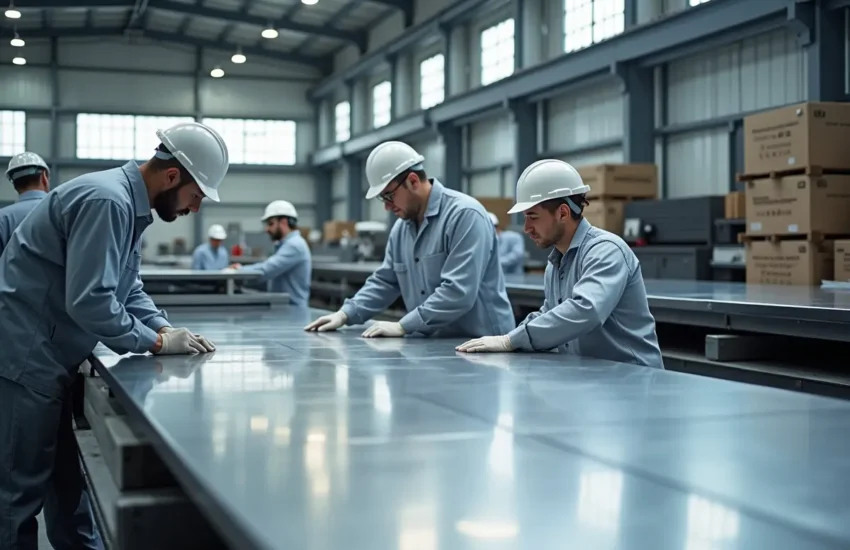
Applications of Engineered Thermoset Composite Materials in Industry
The ability to craft lightweight, strong, and durable structures of almost any conceivable form has made composite materials indispensable across modern industries. Specifically, engineered thermoset composite materials are vital for their superior structural integrity and resilience in demanding environments. This demands manufacturing processes of exceptional precision.
From the colossal blades of wind turbines to the streamlined hulls of marine vessels and advanced transportation systems, the success of these critical applications hinges on meticulous design, tooling, and fabrication. The evolution of advanced composite materials manufacturing has ushered in an era where sub-millimeter accuracy and repeatable quality are not just desired but essential.
In this comprehensive guide, we will explore the intricate world of precision composite manufacturing. We will delve into how master plugs and molds define accuracy, examine the role of cutting-edge technologies like 5-axis CNC machining and sophisticated automation, and uncover the impact of Industry 4.0 on optimizing production. We will also investigate innovations in thermal process control and modular mold designs that are revolutionizing large-scale composite production, ensuring both efficiency and unwavering quality.
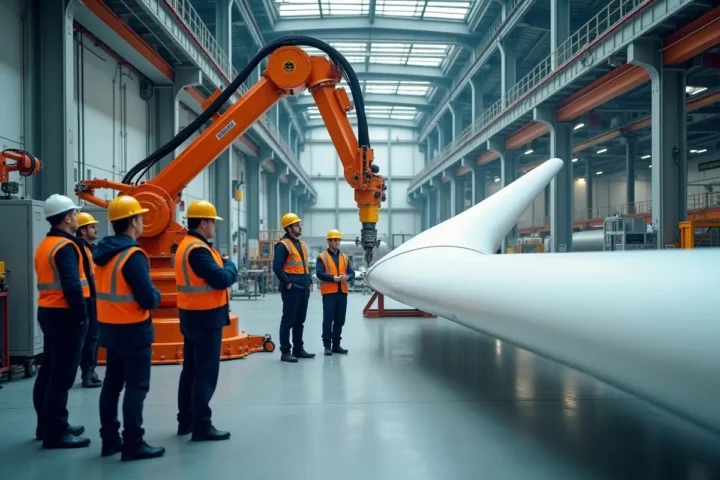
Precision Tooling and Manufacturing of Engineered Thermoset Composite Materials
The foundation of any high-performance composite component lies in its tooling. For engineered thermoset composite materials, such as those utilizing epoxy formulations or vinyl ester resins, the journey from concept to finished product begins with master plugs and subsequently, the molds derived from them.
These tools are not merely forms; they are full-scale, three-dimensional models that dictate the ultimate geometrical accuracy and surface finish of the final composite part. The precision embedded in these initial stages directly translates to the structural integrity and performance of the component, eliminating the need for costly fillers or extensive post-processing adjustments.
Role of Master Plugs and 5-Axis Machining
Master plugs serve as the definitive blueprint for composite molds. Their creation demands extreme precision, often achieved through sophisticated 5-axis CNC machining. This advanced manufacturing technique allows for the creation of complex geometries with sub-millimeter tolerances, ensuring that every curve and contour is perfectly rendered. The durability of these plugs, combined with an impeccable surface finish, is paramount, as they directly influence the quality of every mold produced from them.
With master plugs manufactured via 5-axis CNC, it’s possible to generate more than 25 precise molds, ensuring consistent structural repeatability across an entire production run. This longevity and accuracy are critical for industries that require high-volume, high-precision composite components.
Quality Control for Engineered Thermoset Composite Materials in Structural Tooling
Maintaining tight geometric tolerances throughout the tooling process is non-negotiable. This involves not only the initial machining of master plugs but also the construction of the structural steel support frames that underpin the composite molds. These frames must be welded in-house under stringent ISO standards to ensure they maintain the tight surface geometrical tolerances required for precision manufacturing. For instance, proper shear web alignment within a wind turbine blade mold is crucial for its structural performance, and this alignment is directly influenced by the accuracy of the mold itself.
Furthermore, ensuring the integrity of the vacuum system is vital for successful composite lamination. Vacuum accumulator beams, or even UPS backup options, are critical safeguards to prevent suction loss during potential power disruptions. This foresight prevents costly material waste and production delays. In some innovative designs, a single seamless pipe frame can serve a dual purpose, acting as both a structural truss and a vacuum accumulator, offering protection against suction loss and enhancing overall efficiency.
The meticulous attention to detail in tooling and manufacturing quality control is what distinguishes truly high-performance engineered thermoset composite materials. For more insights into the rigorous standards involved in creating these components, exploring resources on advanced composite materials manufacturing can provide valuable context. Beyond the manufacturing process, non-destructive evaluation techniques are also employed to detect any internal flaws, ensuring the complete structural integrity of the final product.
Key Industrial Applications Across High-Performance Sectors
The inherent advantages of engineered thermoset composite materials—high strength-to-weight ratio, corrosion resistance, and design flexibility—make them indispensable across a spectrum of high-performance sectors. Industries like wind energy, marine, and transportation rely heavily on these materials to achieve structural efficiency, significant weight reduction, and exceptional environmental durability.
Processing Engineered Thermoset Composite Materials for Wind Energy
The wind energy sector, in particular, is a prime example of where precision composite manufacturing shines. The continuous drive for larger and more efficient wind turbines has led to the development of ultra-large wind turbine blades, now spanning from 50 meters to over 150 meters. Manufacturing these colossal structures requires an unprecedented level of precision in tooling and automation.
The aerodynamic profiles of these blades, from root to tip, must be meticulously replicated in the composite manufacturing process to ensure optimal energy capture. Furthermore, the blades must possess exceptional structural fatigue resistance to withstand decades of continuous operation in harsh environments.
The tooling for such blades must also manage immense hinge torque capacities, which can range from 550 to 750 kNm for blades between 50m and 150m in length. The ability to manufacture master plugs and molds capable of serial production for these massive components is a testament to the advancements in precision composite manufacturing.
Marine and Ground Transportation Structural Solutions
Beyond wind energy, engineered thermoset composites are transforming the marine and ground transportation sectors. In marine applications, their superior corrosion resistance makes them ideal for boat hulls, decks, and other structural components exposed to saltwater. Precision marine hull tooling enables the creation of hydrodynamically optimized shapes, leading to increased fuel efficiency and performance.
In ground transportation, composites are increasingly used in rail vehicle cabins, bus bodies, and even structural load-bearing components for trucks and cars. Their lightweight nature contributes significantly to fuel economy and reduced emissions, while their strength enhances passenger safety.
The ability to create complex composite chassis components with precise dimensions allows for innovative designs that were previously impossible with traditional materials. The focus on structural load management and impact resistance makes these materials a preferred choice for the future of transportation.
Advanced Thermal Process Control and Curing Technologies
The curing process is a critical phase in thermoset composite manufacturing, directly influencing the material’s final mechanical properties. Achieving optimal curing kinetics, managing exotherm, and precisely controlling the resin’s glass transition temperature (Tg) are paramount for producing high-quality, durable components. Advanced thermal process control systems ensure thermal uniformity throughout the mold, which is essential for consistent material properties and for optimizing cycle times.
Zoned Heating and Controlled Cooling Ramps
Modern composite molds, especially those for large wind turbine blades, can be divided into up to 300 individual thermal control zones. Each zone is independently monitored and controlled via sophisticated PLC software, often equipped with dual temperature sensors and safety switches. This granular control allows for precise management of cure cycles, ensuring that the resin cures uniformly across the entire structure.
Beyond heating, integrating liquid cooling systems capable of controlled cooling ramps is a game-changer. Cooling ramps of up to 0.4°C per minute can significantly reduce cycle times, sometimes by as much as 60 minutes, while simultaneously improving cure quality and preventing thermal stress-induced defects.
By monitoring surface thermocouples in critical part areas, manufacturers can accurately estimate the cure percentage and Tg progression, leading to a more robust and predictable manufacturing process. This level of thermal management is key to achieving both efficiency and superior material performance.
Modular and Reconfigurable Mold Designs
For the production of very large composite structures, such as wind turbine blades, modular mold architecture offers significant advantages. These molds feature interchangeable upper composite shell sets and retrofittable frames, providing unparalleled versatility. This modularity allows for series conversion, meaning the same core tooling can be adapted for slightly different blade designs or lengths, maximizing equipment reuse and reducing capital investment.
Modular designs also greatly facilitate transportation, as large molds can be broken down into manageable sections. This is particularly beneficial for projects that adopt ‘separated manufacturing, on-site assembly’ models for ultra-large composite structures, where final assembly occurs at the installation site.
Here’s a comparison highlighting the benefits:
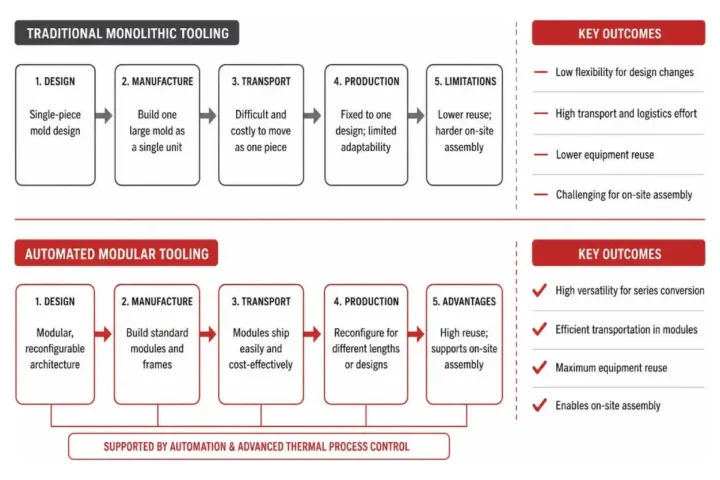
Key advantages of modular mold systems include:
- Series Conversion Versatility: Easily adapt tooling for variations in product design or length.
- Efficient Transportation: Sections can be transported more readily than a single, monolithic mold.
- Maximum Equipment Reuse: Core platform components can be retrofitted for different projects, extending their lifecycle.
- On-Site Assembly Support: Facilitates the production of components that are too large to transport fully assembled, enabling final assembly at the operational site.
- Reduced Capital Expenditure: By reusing and reconfiguring existing modules, the need for entirely new tooling sets is minimized.
This flexibility is crucial for industries facing rapidly evolving product designs and the need for scalable production models.
Automation, Material Handling, and Industry 4.0 Integration
The drive for increased efficiency, repeatable quality, and enhanced workplace safety standards has propelled manufacturing automation to the forefront of precision composite production. By integrating advanced automation solutions and leveraging Industry 4.0 principles, manufacturers can optimize workflow, reduce reliance on manual labor, and achieve unprecedented levels of precision.
Automated Edge Grinding, Laminating, and Root Milling
Manual processes in large-scale composite manufacturing are labor-intensive, prone to inconsistencies, and can pose safety risks. Automated systems are transforming these operations. For instance, automated surface grinding systems, often deployed via robotic AGVs, can precisely grind the leading and trailing edges of large composite blades. Utilizing 1000mm grinding heads instead of standard 800mm heads not only provides a 25% larger surface area for faster processing but also reduces consumable usage by at least 20%. These systems also boast high dust removal efficiency, often reaching 98% or higher, significantly improving workplace safety and environmental conditions.
Similarly, purpose-built laminating carts are replacing manual laminating, entirely eliminating crane dependency and drastically reducing labor requirements. These carts ensure consistent material placement and compaction, leading to higher quality laminates. For post-processing, intelligent root milling machinery performs high-precision milling of pre-embedded bolt sleeves on composite blade roots. This automation ensures exact fitment and structural integrity, crucial for the blade’s connection to the turbine hub.
Smart Mold Management Software and AGV Logistics
Industry 4.0 plays a pivotal role in optimizing composite manufacturing through smart mold management software, such as Mouldlink. This software enables real-time thermal monitoring of molds, providing operators with critical data on cure progression, temperature distribution, and potential anomalies. This level of control allows for proactive adjustments, ensuring optimal curing and preventing defects.
Automated guided vehicles (AGVs) and integrated material handling solutions are streamlining the entire production workflow. Central AGV platforms, often guided by sub-rail systems, optimize root-to-tip material flow and glue application workflows within large composite mold layouts. This minimizes manual material handling, reduces the risk of error, and accelerates production.
Furthermore, automated web positioning gantries, which can utilize existing mold hydraulic clamps, avoid the need for additional capital investment in external actuators, demonstrating clever integration of existing infrastructure. An example of such innovation is the deployment of a modular gantry system that uses seamless pipe frames as vacuum accumulators, maintaining part grip even during power outages. These integrated systems represent a significant leap forward in production efficiency and reliability.
Frequently Asked Questions about Advanced Thermoset Tooling
How do master plugs define the geometric accuracy of large thermoset molds?
Master plugs act as three-dimensional full-scale models. When machined with extreme accuracy, typically via 5-axis CNC equipment, and supported by rigid steel structures, they allow for the creation of high-precision molds. This precision ensures that internal components, shear webs, and inserts fit consistently without requiring costly fillers or manual adjustments, directly dictating the final accuracy of composite parts.
What are the benefits of modular mold designs for large-scale production?
Modular mold designs offer several advantages for large-scale composite fabrication. They feature interchangeable upper composite shell sets and retrofittable frames, allowing for series conversion versatility, efficient transportation of mold sections, and maximum reuse of platform equipment. This architecture also supports on-site modification and assembly, which is crucial for ultra-large structures that are challenging to transport fully assembled.
How do zoned heating and cooling systems optimize cycle times?
By dividing large composite molds into hundreds of independently monitored heating zones, controlled via sophisticated PLC software, and integrating liquid cooling systems capable of precise cooling ramps (e.g., 0.4°C/min), cycle times can be significantly reduced. This precise thermal process control ensures optimal resin cure, minimizes internal stresses, and can shorten production cycles by up to 60 minutes while maintaining or even improving the quality of the cured composite part.
Conclusion
The journey through precision composite manufacturing reveals a sophisticated ecosystem of design, engineering, and automation. From the foundational accuracy instilled by 5-axis CNC machined master plugs to the intricate thermal control of zoned heating systems and the streamlined efficiency of Industry 4.0-driven automation, every element contributes to the creation of high-performance engineered thermoset composite materials.
This meticulous approach is not just about producing parts; it’s about enabling the next generation of wind energy solutions, advancing marine and transportation capabilities, and pushing the boundaries of what is structurally possible. The continuous evolution of composite tooling, coupled with seamless vertical integration and robust global support networks, ensures that manufacturers can achieve short lead times, cost-effective production, and unwavering quality. As we look towards August 2026 and beyond, the emphasis on precision engineering, operational safety, and scalable production models will undoubtedly continue to drive innovation in advanced composites.