
Truck Accident Safety on Colorado’s Highways: How the State Is Responding to Challenges on I-70 and I-25
Trucking on Colorado’s I-70 and I-25 corridors is uniquely demanding — steep mountain grades, rapid weather changes, dense Front Range commuter traffic, and chain-up requirements all stack risk in ways flatland routes don’t. When 18-wheelers crash on these roads, the consequences are disproportionate: catastrophic injury or fatality is the baseline outcome rather than the exception.
Colorado has responded with a layered enforcement, technology, and regulatory framework — but for the people actually injured in these crashes, securing competent legal guidance from a Denver truck accident attorney is what translates that framework into compensation.
Reducing crashes on these corridors isn’t only an infrastructure question. It’s an enforcement question (FMCSA hours-of-service compliance, vehicle maintenance, driver qualification), a technology question (ELD records, ECM/EDR data, in-cab safety systems), and an insurance question (financial responsibility minimums, layered policies, contingent coverage). This article walks through how each element fits and what it means for road users and crash victims.
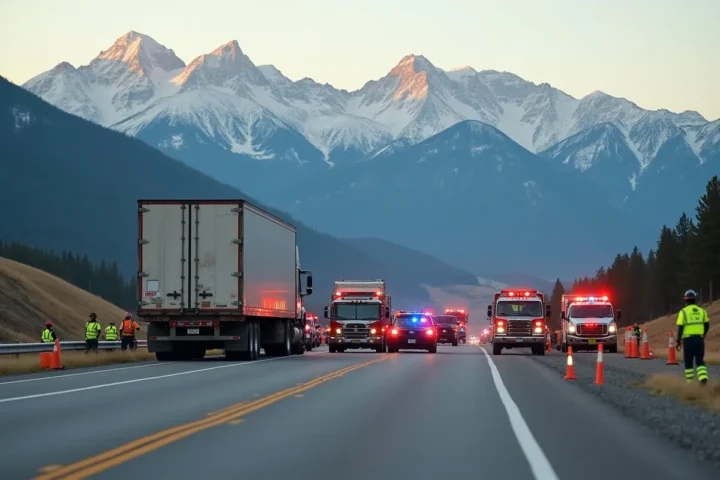
FMCSA Rules and Enforcement on Colorado Highways
FMCSA regulations set strict, federally enforced standards covering driver hours of service, vehicle weight, brake and tire condition, and required maintenance records. Colorado adopts these rules under 8 CCR 1507-1 and enforces them through the Colorado State Patrol’s commercial vehicle enforcement unit, working in coordination with CDOT.
CSP runs thousands of inspections a year at fixed weigh stations on I-70 (Dumont, Edwards) and I-25 (Monument, Trinidad) and at roving inspection sites along the corridors. The enforcement focus ranges from cab-card violations and driver license/medical card issues to brake adjustment, tire condition, and ELD log compliance with the 11-hour driving/14-hour duty/60-or-70-hour weekly limits.
Recent CSP commercial-vehicle data consistently shows a meaningful percentage of post-crash investigations identify driver-related regulatory violations — fatigue, hours-of-service falsification, equipment defects, or operating-while-out-of-service findings. Increased inspection frequency in mountain passes and weather-driven conditions remains a CSP priority, particularly during winter chain law activations on I-70.
Black Box Evidence and Its Crucial Role
Modern commercial trucks carry electronic control modules (‘black boxes’), and most carriers now run electronic logging devices (ELDs) and dashcam systems. The evidentiary value is enormous: ECM data captures pre-crash speed, brake application, throttle position, and engine RPM, while ELDs document hours-of-service compliance and dashcam footage shows driver behavior at the moment of impact.
In civil cases, this data is the difference between a defended liability dispute and a clear assignment of fault — and it disappears fast. Most carriers’ retention policies allow ECM/ELD data to be overwritten within days or weeks unless a preservation letter is in place. PI counsel sends those preservation demands within hours of being retained.
Commercial Insurance and Accountability
Colorado’s commercial trucking insurance environment combines federal minimums under 49 CFR Part 387 ($750,000 for general freight, $1 million for oil transporters, $5 million for hazardous materials carriers) with state vehicle insurance requirements and motor carrier registration rules. Most large fleets carry well above the federal floor, with primary commercial auto coverage of $1 million and excess/umbrella layers reaching $5–25 million for major carriers.
Successful claims often involve coordinating multiple policies — primary, excess, umbrella, and contingent coverage from shippers or brokers — which is why specialized trucking PI counsel materially outperforms generalists. Insurer disputes routinely involve named-driver exclusions, broker vs. carrier liability allocation, and interstate vs. intrastate coverage triggers.
I-70 and I-25 Trucking Corridors: Unique Challenges
I-70 carries hundreds of billions in annual freight movement east-west across Colorado, and the mountain grades from the Eisenhower Tunnel west through Vail Pass, then Glenwood Canyon to Grand Junction, are among the most demanding commercial truck terrain in the U.S. The Floyd Hill stretch (mile markers 245–248), the descent from the tunnel, and the Vail Pass approach have all generated multiple multi-vehicle fatal-crash patterns over the years.
Brake fade, runaway-truck incidents, and chain-restriction noncompliance are recurring causes; runaway truck ramps exist (Floyd Hill, Vail Pass, Glenwood), but are underutilized when drivers don’t recognize fade early enough.
I-25, the north-south spine, has different challenges: the Front Range concentration of commuter and commercial traffic between Castle Rock and Fort Collins produces high crash density, exacerbated by frequent construction zones (the Gap project, Crossroads work), unpredictable weather, and merging conflicts at major interchanges (US-36, I-225, I-70, US-34).
Multi-vehicle pile-ups in winter low-visibility conditions are a recurring pattern of fatal crashes. CSP’s targeted education and intervention efforts — portable inspection stations, in-cab safety alerts via Drivewyze, and corridor-specific enforcement campaigns — focus on these high-risk segments.
Statewide Collaborations and Technological Advancements
Colorado has been an early adopter of trucking safety technology. Drivewyze in-cab messaging warns drivers of upcoming weigh stations, road conditions, and steep grades; PrePass connectivity speeds compliant carriers through inspection points while concentrating attention on higher-risk traffic. Automated inspection technology improves compliance verification, and real-time data sharing between CSP, CDOT, FMCSA, and neighboring-state enforcement enables faster post-crash response and pattern detection.
Effective safety improvement requires partnership — CSP and CDOT on enforcement, the Colorado Motor Carriers Association on industry self-policing and education, and the plaintiff and defense PI bars on the civil-accountability piece. Campaigns like ‘The Mountain Rules’ translate Colorado-specific terrain risks into actionable driver guidance. The result is a cooperative model that delivers measurable improvements in crash trends over time.
Conclusion
Reducing 18-wheeler crashes on Colorado’s most demanding corridors is an ongoing, multi-actor effort. FMCSA enforcement, ECM/EDR and ELD evidence, layered commercial insurance frameworks, and corridor-specific education on I-70 and I-25 each contribute to the safety system.
For people injured in trucking crashes on these roads, the same framework also creates the evidentiary and insurance foundation for substantial civil recovery — but only when counsel acts quickly enough to preserve the data, identify the responsible carriers, and put together the multi-policy claim. Conduit Law represents truck-crash victims along Colorado’s I-70 and I-25 corridors and into the broader Mountain West; the consultation is free, and the preservation window starts running on day one.