Assistive Technology Makes Us Larger Than Life
One of the world’s best technology shows, CES 2026 in Las Vegas, was dominated this year by AI-everywhere: smarter robots, futuristic displays, and next-gen mobility, with more than 4,000 exhibitors showing where consumer and industrial tech are heading.
AI computers, exoskeletons, and sensor-rich wearables are part of a broader shift from “productivity tech” to assistive tech. Voice, gesture, and AI assistance lower the barrier to using complex systems, while advanced mobility tech, from better driver assistance to full-on robotaxis, work not just as a convenience for multi-taskers, bur also preserve freedom of movement for those who can no longer safely drive but still need to get somewhere.
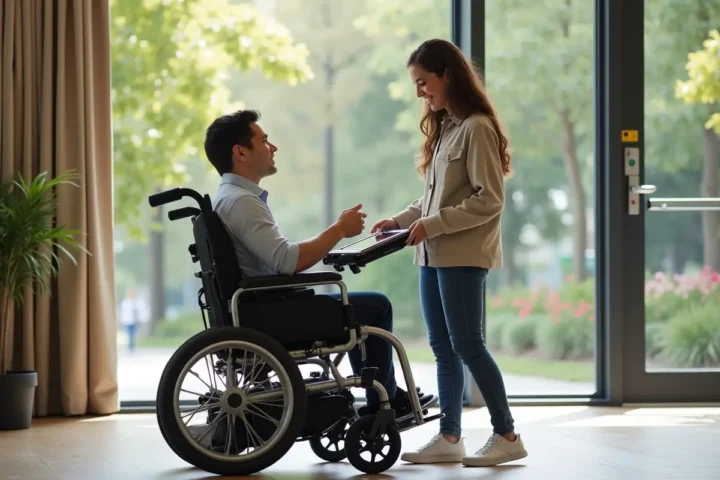
Alan Wu, CMO of Bay Alarm Medical, a medical alert device manufacturer, was at the show and noted how the future of tech is also the future of aging, and aging in place:
“Robots that can climb stairs, move loads, or provide companionship make it more possible for the elderly or disabled to live independently in their own home.”
Here are selections from the huge assortment of innovations at CES 2026.
Big Themes
From laptops and TVs to smart homes and cars, most “new” products were really AI-first versions of things you already know. Chipmakers like NVIDIA, AMD, Intel, Qualcomm, and others pushed new CPUs, GPUs, and NPUs aimed at faster on-device AI for PCs, phones, and edge devices.
For enterprise and industrial AI, Siemens unveiled its Digital Twin Composer, which combines Siemens’ digital twin stack with NVIDIA Omniverse to simulate products, plants, and processes over time for resilience and precision in industrial settings.
CES leaned hard into physical AI, with autonomous robots for cleaning, delivery, personal mobility, and companionship roaming the show floor. Mobility was key, as autonomous vehicles, robotaxis, and advanced EVs were a core pillar, with demonstrations across the West Hall and outdoor test tracks.
The digital health boom embraced AI-enhanced wearables, smart rings, health-focused toothbrushes, and hydrogen water bottles, all showing how healthcare technology is becoming always-on and deeply personal.
Standouts
How about a stair-climbing robot as a vacuum? Roborock’s Saros Rover prototype was one of the most talked-about home robots, using articulated wheel-legs to haul itself up stairs, step by step, and then fold the mechanism away for flat-floor cleaning.
For AI pet and cyber companions, this year’s show offered multiple AI “pets” that blend conversational models, sensors, and robotics to act as always-available companions, underscoring the push toward emotional as well as functional robotics.
The rollable gaming laptop from Lenovo, the Legion Pro Rollable, uses a 16-inch flexible OLED that expands sideways from a standard 16:10 into 21:9 or even 24:9 format, effectively turning a normal gaming laptop into a built-in ultrawide rig.?
Paper-thin and flexible displays were a stunning hit. Across the floor, ultra-thin TVs and flexible screens previewed how media consumption could move beyond fixed rectangles into rollable and wall-hugging formats.
Beauty and home wellness tech also had a place: L’Oréal showed an LED eye mask and a smart face mask system, while hair tools like the Lighty Straight & Multi Styler targeted salon-grade results with less heat damage.?
Healthcare Tech
Health-focused smart rings and watches emphasized continuous tracking of sleep, stress, and metabolic signals, often paired with AI-driven coaching for behavior change and longevity. There was even a smart water bottle: Echo’s bottle infuses molecular hydrogen into water, links to Wi-Fi/Bluetooth, and tracks hydration, with the latest version offering 50% better battery life.?
Baracoda’s AI toothbrush analyzes brushing quality, while its BConnect Hub aggregates bathroom device data to flag early warning signs for cardiovascular and diabetes risk, launching the concept that the home most accident-prone room can instead monitor for preventive care.?
Exoskeletons and movement support: Digital health exhibitors also showed exoskeletons aimed at mobility support, elder care, and rehab, blending robotics with therapeutic use cases.
And robots that can climb stairs, move loads, or provide companionship are not about avoiding housework; they’re about making it possible for someone frail, disabled, or recovering from illness to live independently, with dignity, in their own space rather than in an institution.
Mobility and Autonomy
NVIDIA’s Vera Rubin delivered autonomous driving with its Vera Rubin architecture, promising more than triple the performance of its Blackwell line and up to 5x faster inference for AI workloads, emphasizing efficiency per watt for data centers and edge.??
Also for self-driving cars, NVIDIA announced Alpamayo, an open AI model and toolset meant to bring richer reasoning to autonomous vehicles – Mercedes-Benz cars using this system are expected on roads starting Q1, 2026.?
Uber’s robotaxi with Lucid and Nuro revealed a “production intent” robotaxi based on a Lucid Gravity SUV platform, bristling with cameras, lidar, radar, and a roof-mounted “halo” that improves sensor visibility and doubles as an LED info bar for riders. Inside, up to six passengers get a large screen for climate, media, seat heating, and emergency controls.?
New energy and EV ecosystems highlighted battery-electric, hydrogen fuel cell, plug-in hybrid, and extended-range EVs covering everything from e-bikes to heavy construction vehicles. Also we saw residential and grid-scale storage, smart-home energy managers, portable power, and even some small modular nuclear and fusion concepts on display.?
AI PCs and Friendly Robots
Lenovo turned the Las Vegas Sphere into an immersive AI showcase, announcing its Lenovo Qira AI platform, new ThinkPads in the Aura edition line, and Motorola’s first book-style folding phone, the Razr Fold. The show also pushed laptops and desktops built around new AI-centric chips, with on-device models handling summarization, creative tools, and personalization, all without constantly hitting the cloud.
The smart home story shifted from “connected” to predictive: AI-driven systems now learn routines and adjust lighting, appliances, security, and thermostats automatically to balance comfort, cost, and sustainability.
And service robots for hotels, malls, and retail mixed navigation, manipulation, and customer interaction, suggesting that “robots as a service” will be a bigger B2B theme over the next few years.
Much of what showed up at CES 2026 aims to extend human capability, especially where people need it most. An AI-driven home that can predict routines, adjust lighting, and control appliances goes beyond convenience into actual lifestyle safety. Smart health devices that monitor heart rate, sleep, gait, and bathroom metrics equip every home with an early warning system. And as Alan Wu notes, “Robots are probably the biggest thing that will change the way we live.“