A Plan Built for Your Child: Turning Assessment, Motivation, and Daily Routines Into Meaningful Progress
Families often start looking for therapy support because something in daily life feels stuck. Maybe mornings are chaotic and exhausting. Maybe transitions lead to meltdowns. And Maybe your child understands more than they can express and frustration shows up as hitting, screaming, or shutting down.
Maybe school is reporting challenges with attention, waiting, following directions, or peer interactions. In many cases, caregivers have already tried visual schedules, reward charts, social stories, and different routines. Sometimes these tools help for a while, and then the progress fades.
That is usually not because the family is inconsistent. It is often because the plan does not fully match the child’s needs, learning style, and real-life environment. “Consistency” only works when the strategy is actually teachable, motivating, and sustainable for that specific child.
This is where Personalized ABA Therapy can be valuable as an educational framework for building skills. When supports are individualized, goals feel meaningful, reinforcement fits the child, and teaching methods match how the child learns best. The focus becomes less about trying to force a child through hard moments and more about teaching practical skills that reduce stress and increase independence.
In this guest post, you will learn what personalization looks like in practice, how goals are selected, why motivation and environment matter, and how families can tell whether progress is truly happening. You will also find concrete examples, bullet points, and step-by-step strategies that you can adapt to your child’s routines.
What “personalized” really means
Personalization is sometimes misunderstood as simply letting a child choose a toy or picking a few preferred activities. Real personalization is deeper. It means the plan is built around multiple layers of information, including:
- Communication profile: speech, gestures, AAC use, receptive understanding
- Learning style: visual strengths, imitation skills, attention patterns, processing speed
- Motivation: what the child works for, what calms them, what helps them re-engage
- Sensory needs: noise sensitivity, movement seeking, texture preferences, overwhelm triggers
- Executive functioning: flexibility, transitions, planning, initiation, emotional control
- Family routines: what actually happens at home, what is realistic to practice, what matters most
- School and community demands: classroom expectations, peer settings, community outings
- Cultural context: values, language, household priorities, acceptable routines
A plan is personalized when it fits the child and the family, not just a generic checklist of skills.
The first step: understanding the “why” behind challenging moments
When a child struggles, the behavior is often serving a purpose. It might be how they escape a hard task, get access to something they want, communicate discomfort, or manage sensory overload. If adults respond only to the surface behavior without addressing the function, improvement tends to be short-lived.
Common behavior functions include:
- Escape: “I want this to stop.”
- Access: “I want that item or activity.”
- Attention: “I need connection.”
- Sensory: “My body needs input” or “this input is too much.”
Personalization means identifying what the behavior is communicating and teaching a replacement skill that meets the same need more effectively.
Example: transitions from screens
- Behavior: screaming when the tablet is turned off
- Possible function: escape from stopping, difficulty transitioning, anxiety about what is next
- Replacement skills: timer transitions, first/then supports, asking for “one more minute,” choosing the next activity, requesting a break
The goal is not to “win” the transition. The goal is to teach skills so the transition becomes predictable and manageable.
Building goals that make daily life easier
Personalized plans prioritize skills that improve quality of life, reduce distress, and build independence. A good way to choose targets is to look at daily pain points and identify teachable replacement skills.
High-impact goal areas
Functional communication
- Requesting help
- Requesting a break
- Refusing appropriately (all done, no thank you)
- Making choices
- Sharing basic information (name, needs, pain, tired)
Emotional regulation and coping
- Using a calm-down routine
- Recovering faster after overwhelm
- Tolerating small changes
- Waiting briefly
- Accepting “later” with support
Daily living skills
- Dressing steps
- Toileting routines
- Handwashing and hygiene
- Mealtime participation
- Sleep and bedtime routines
Participation and learning readiness
- Sitting for short tasks
- Following one-step directions
- Transitioning between activities
- Engaging in play routines
- Joining group activities briefly
A personalized plan chooses the right starting point and the right teaching approach for each area. For example, two kids might both need help with toothbrushing, but one needs sensory supports and gradual exposure, while the other needs a visual sequence and reinforcement for completing each step.
School readiness is more than letters and numbers
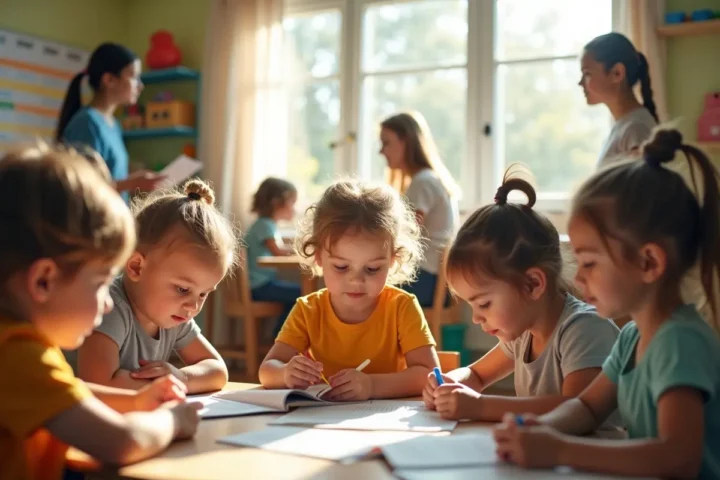
When families think about kindergarten preparation, they often focus on academics. In reality, kindergarten success depends heavily on participation skills: following directions, transitioning, waiting, communicating needs, and handling group routines.
Skills that often matter most include:
- Sitting for a short group activity
- Following simple classroom directions
- Waiting for turns
- Transitioning when a timer ends
- Asking for help
- Tolerating “not right now”
- Cleaning up materials
- Moving safely in a group
Many families work on these skills at home in a gentle, routine-based way, practicing mini versions of classroom expectations. This can look like using short “circle time” routines, clean-up routines, and simple work-then-break patterns, the same foundational approach reflected in school readiness routines.
A home-friendly way to practice school readiness
Try this 10-minute structure:
- Two-minute warm-up: a preferred activity to build connection
- Two-minute table task: puzzle, matching, coloring, or a simple sorting activity
- One-minute break: movement or sensory play
- Two-minute clean-up: put away 5 items with help as needed
- Two-minute “group” routine: song, story page, or short listening activity
- One-minute choice: child chooses the next activity
This builds attention, transitions, and participation without turning home into school.
Communication growth depends on how language is taught and reinforced
Communication can improve dramatically when it is taught functionally and practiced in real routines. Children often need language they can use immediately to reduce frustration.
High-value functional language targets include:
- “Help”
- “Break”
- “All done”
- “More”
- “Wait”
- “My turn”
- “Stop”
- “Bathroom”
These can be spoken, signed, pictured, or device-based. Personalization means selecting the form that is easiest and most reliable for that child.
Many children learn communication best when adults:
- Model language repeatedly in context
- Create natural reasons to communicate
- Prompt gently, then fade prompts over time
- Reinforce attempts immediately
- Practice in many environments, not only at a table
This practical emphasis on functional communication and consistent reinforcement aligns with the same skill-building principles discussed in speech and language support strategies.
A quick communication teaching example: “help”
Use a routine that naturally creates a “stuck” moment.
- Give a slightly challenging task (container, puzzle, zipper).
- Pause for 3 seconds.
- Prompt “help” in the easiest format (word, sign, picture).
- Provide help immediately.
- Repeat across the week in short moments.
Over time, the child learns that asking for help is faster and more effective than escalating.
Reinforcement that actually fits the child
Reinforcement is not a universal reward chart. Personalization means reinforcement matches what the child values in that moment, and it is delivered in a way that supports learning.
A good reinforcement plan is:
- Immediate: especially for new skills
- Clear: the child knows exactly what earned it
- Flexible: reinforcers rotate so they stay motivating
- Respectful: avoids using reinforcers that create distress or shame
Examples of reinforcer categories:
- Sensory: water play, kinetic sand, fidgets
- Movement: jumping, swinging, quick walk
- Tangible: favorite toy, building set
- Activity: music time, drawing, short game
- Food: small preferred snack (when appropriate)
Measuring progress without turning life into constant data collection
Families often worry that tracking progress will be burdensome. In practice, personalization includes choosing measurement that is simple and meaningful.
You can track progress with:
- Success rate: out of 10 transitions, how many were smooth
- Prompt level: how much help was needed
- Duration: how long a meltdown lasted
- Independence: how many steps were completed without help
The goal is to know whether the plan is working and what to adjust, not to create perfect charts.
A simple weekly tracking idea
Pick one routine, one target skill, and one measurement.
Example:
- Routine: bedtime
- Skill: tolerates toothbrushing
- Measurement: duration
- Record: seconds tolerated each night
Small, consistent tracking beats complicated systems you never use.
How families can tell if a plan is truly personalized
A personalized plan tends to feel practical, not performative. Signs of genuine personalization include:
- Goals are tied to the child’s daily life and family priorities
- The team adjusts strategies when something is not working
- Reinforcement matches the child’s motivation, not generic rewards
- Teaching happens in natural routines, not only at a table
- Caregivers are coached with realistic steps
- Progress is reviewed with concrete examples and measurable data
- Skills are practiced across settings, not limited to one environment
If these elements are missing, progress may stall because the plan is not truly matched to the child.
Conclusion
When support is individualized, progress becomes easier to sustain because the plan fits who the child is. Personalization means understanding the reasons behind challenging moments, choosing goals that make daily life easier, teaching skills in manageable steps, and using reinforcement that genuinely motivates the child. It also means measuring progress in simple ways so families can adjust strategies and celebrate real change.
Whether the focus is school readiness, communication, coping skills, or daily living routines, the most meaningful gains often come from small, consistent steps practiced in real life. Over time, those small steps can build into big gains: smoother routines, fewer crises, stronger self-advocacy, and more confident participation in home, school, and community life.